

Navigating the complex world of product development is like embarking on an ambitious expedition. Just as explorers rely on a well-crafted roadmap to guide their journey, product development teams require a robust plan for success. Enter the product requirements document (PRD), a vital tool for product teams that serves as a compass, directing teams back to the desired destination of a successful product.
In this blog post, we’ll delve into the value of product requirements document templates. We’ll explore the key factors that make up a good product requirements document template and introduce you to five excellent templates that will revolutionize your product development work. These templates will serve as guides on your journey to delivering exceptional products.
Discover how these templates can streamline your product development process, align your core team with your product strategy, and navigate the complexities of bringing a successful product to market.
What is a Product Requirements Document Template?
A well-crafted product requirements document template provides a predetermined structure that helps teams effectively organize and align their efforts. Gives teams a shared understanding of the end product’s features, functionality, and specifications among other teams and multiple stakeholders.
The template acts as a framework to capture essential information such as user requirements, business objectives, technical and functional specifications, project timelines, and key milestones.
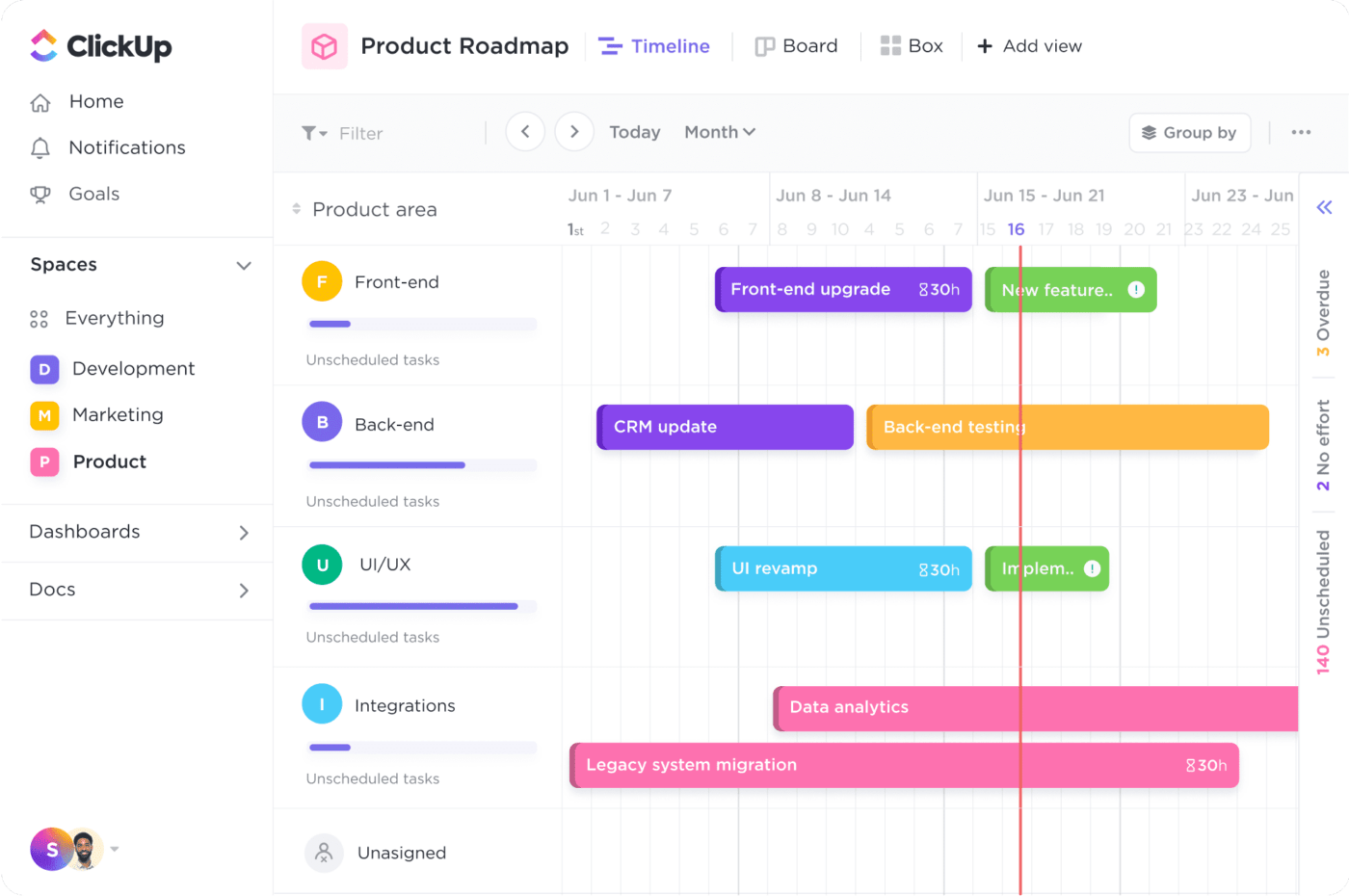
Using detailed information and following the structure outlined in the model, teams can make informed decisions at each stage of the product development process. This structured approach not only increases clarity but also reduces the risk of miscommunication or oversight.
A product requirements document template plays a key role in driving efficiency. It provides a standardized format that promotes consistency, coherence, and shared goals across the entire development team.
This consistency helps save time and effort, allowing teams to focus on core tasks and success metrics. A template streamlines workflows and promotes collaboration because it ensures the entire team is aligned on the same path to success.
What makes a good product requirements document template?
Here are the key aspects of a good product requirements document template:
- Comprehensive: Covers all aspects relevant to a product development team
- Ease of use: Easy to use and supports continuous updates
- Effective communication: Facilitates clear communication between team members and stakeholders
- Long-term planning and decision tracking: Provides a structured framework for documenting decisions and supports long-term planning deadline
- Transparency and accountability: increases transparency and accountability in the decision-making process by defining who is responsible for which parts of the process
- Flexibility: allows customization to meet needs project-specific
How do product requirements models benefit product managers?
Product managers need to align stakeholders, capture product requirements, and communicate effectively with the product team. Product requirements templates provide valuable benefits that address these challenges and improve the work of PMs.
Product requirements templates help product managers because they:
- Simplify requirements gathering by providing a structured framework
- Increase clarity and communication by providing a standardized format for the development team
- Facilitate stakeholder alignment through clear visualization of product features and objectives
- Enable iterative refinement of requirements to adapt to evolving needs
- Foster collaboration across teams and reduce miscommunication so everyone stays on the same page
A product requirements document (PRD) can also help a product manager with the task management side of product management because it gives everyone a single source of truth about the product. As a result, product managers can assign work to their product development team with greater efficiency and effectiveness.
5 Product Requirements Document Templates You Should Try
When it comes to product development, having the right tools at your disposal can make all the difference. That’s why we’ve curated a collection of five must-have templates designed to simplify your development process and ensure product success.
Let’s dive in and discover the perfect template for your next project!
1. Product Requirements Document Template by ClickUp
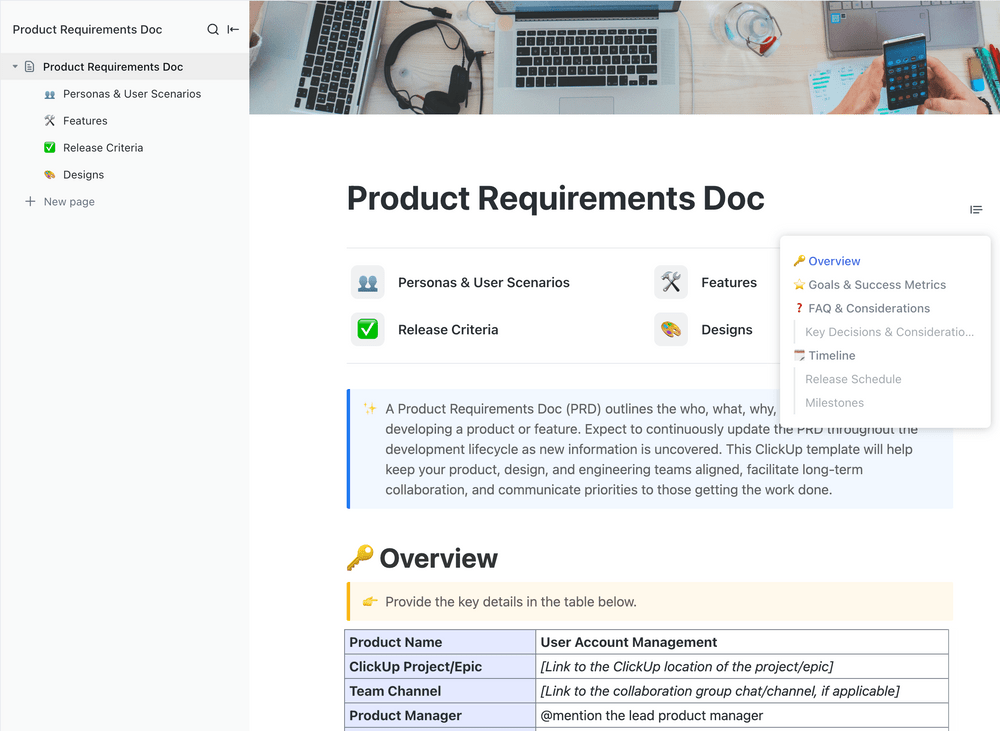
The ClickUp Product Requirements Document Template is the perfect roadmap to guide you on your journey. Just like a reliable compass points north, this model helps your product manager stay on track. ClickUp’s product requirements document template is a great starting point for beginners. This template serves as a blueprint, clearly describing the features, functionality, and specifications of a product. It guides the development process and aligns stakeholders on the desired outcome.
A Product Requirements Document (PRD) answers questions such as who the stakeholders are in a project, what the goal of the project is, when the project is due, and how your team will accomplish it.
PRDs are not expected to sit on a shelf to gather dust. Instead, you should always update the PRD to accommodate new information as you go, which keeps everyone informed and in sync.
This is a great tool for your product, design, and engineering teams to stay in sync with each other and communicate clearly throughout a project.
Format your document to suit your needs, whether you’re creating a roadmap or a knowledge base. Organize your information with tables, nested pages, and styling options. Then make it easy to quickly find the information you need by incorporating bullet points to simplify your product strategy.
The template includes essential sections for defining the timeline, release schedule, goals, success metrics, product milestones, end-user personas or user stories, features, and launch criteria.
2. Product Requirements Template by ClickUp
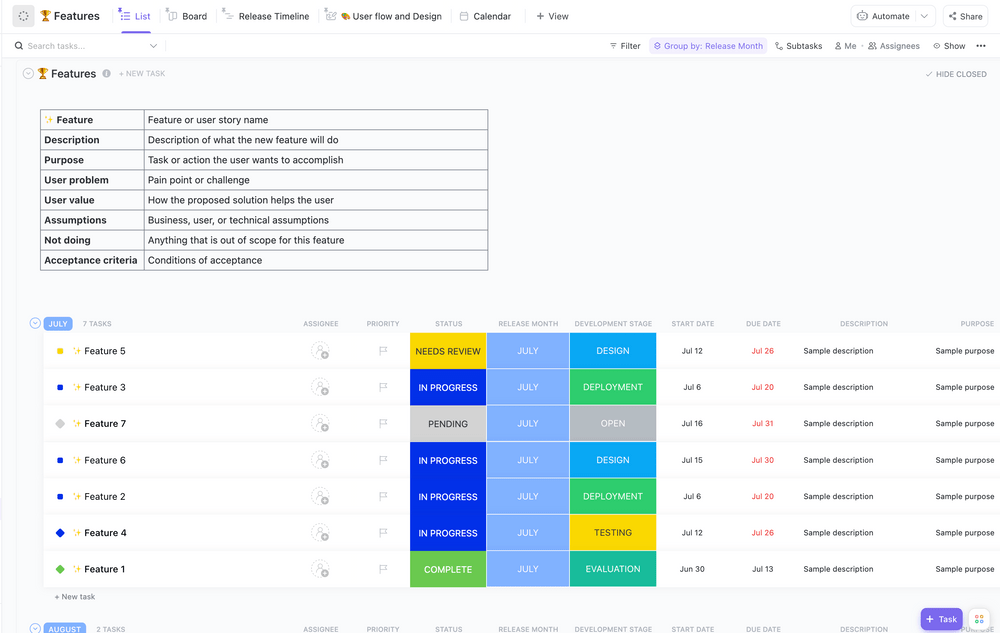
As you make your way through the wilderness of product development, this product requirements template from ClickUp is your survival toolkit. It builds on the fundamental principles established in the previous template, providing additional tools to help you document product decisions and create comprehensive release plans for complex products.
Use this template to keep lines of communication open and consistent between everyone involved in a project. Decisions come fast and furious during product development, so this is a practical way to record what those decisions were, who was involved in the decision, and why the decision was made.
This historical information prevents teams from duplicating work as they create release plans or unnecessarily undoing features without understanding why those features were created in the first place.
This template comes with features like time tracking, dependency warnings, milestones, and custom fields. Teams can edit the document together at the same time, tag teammates with @mentions, convert messages into tasks, and assign those tasks to the right person.
ClickUp Product Requirements Template: List View
ClickUp’s default list view is the best way to group tasks, sort information, and filter data quickly! Each ClickUp plan offers unlimited list views, so don’t be shy about using them early and often.
In List View, you can drag and drop text to convert it into tasks and subtasks. ClickUp’s colored lines connect between each level of your project, so you don’t lose track of where each assignment resides in the project hierarchy.
ClickUp Product Requirements Template: Board View
You can easily create a flexible Kanban system in ClickUp to visualize your product development project. Label and organize each column however you want, then group the data by status, priority, role, and more.
As your project changes, you can update tasks in bulk and change assignees without leaving Board View.
3. Project Management Requirements Template by ClickUp
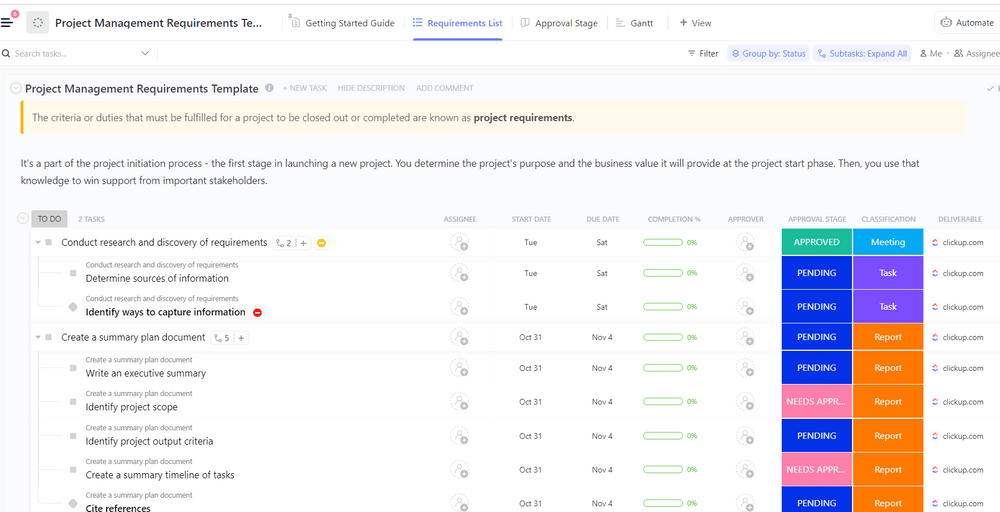
Think of ClickUp’s project management requirements template as your jet pack into the project management realm. Just as the previous template prepared you for the journey, this one propels you forward by providing a structured framework for project management information and facilitating the entire project lifecycle.
This beginner-friendly template helps with effective planning, communication, and execution throughout the project lifecycle. It will also help you manage your resources and keep an eye on your project controls. Access everything in one place by linking documents and tasks.
Add widgets to update workflows, change project statuses, assign tasks, and more, all in your editor. This template lets you group, sort, and filter tasks, update tasks in bulk, and change task statuses quickly.
It also lets you assign approvers and view each task’s progress via a handy percentage bar, keeping everyone updated on the current status and how close each task is to completion.
4. Business Requirements Document Template by ClickUp
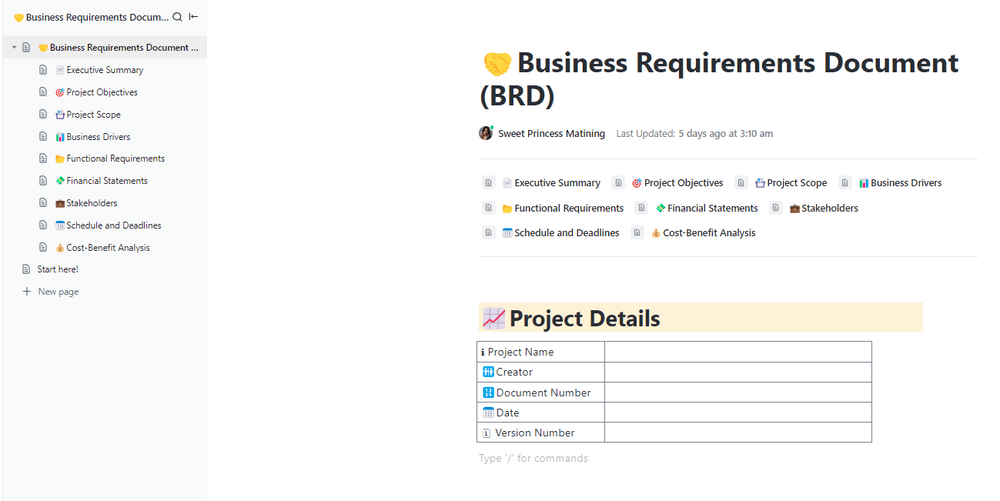
Your product development journey has been exciting so far. But now it’s time to do business. Enter the ClickUp Business Requirements Document Template, a powerful tool designed to clearly outline the business side of a project and align all stakeholders on the team’s knowledge needs and objectives.
This live document template includes space for you to tie the reason for this project directly to the needs of your users and ensure you meet their expectations. Then you can overcome any obstacles that may stand in your way as you move forward on your mission to improve the lives of your users.
The ClickUp business requirements document template helps you outline a business solution for a project. It captures and documents the specific needs and objectives of a company or organization when starting a project or developing a new product or service.
This model ensures clear communication, alignment, and a comprehensive understanding of business objectives and requirements among stakeholders and project teams.
This document covers a number of essential aspects, including project objectives, project scope of work, drivers of deals, customer interviews, user stories, functional requirements, financial statements, stakeholders, timelines, deadlines, and cost-benefit analysis.
Now you have a complete solution for understanding and documenting users’ needs and expectations, the motivation for a solution, and any key roadblocks in your product’s capabilities.
ClickUp makes it easy to keep all this information centralized for easy access and quick searches. You can organize your assets to track resources and create company wikis right in your workspace.
5. Microsoft Word Product Requirements Document Template by SampleTemplates
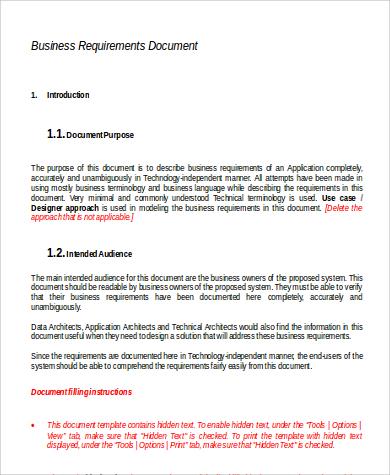
Just like an experienced explorer, you have successfully overcome the challenges of product development so far. Now it’s time to take your knowledge to the next level. SampleTemplates’ Microsoft Word Product Requirements Document Template is the best solution for a detailed tool, ensuring you leave no stone unturned in your pursuit of product excellence.
This product requirements document template from SampleTemplates is a comprehensive tool that helps people understand the purpose of a product, how it works, its functional requirements, technical purpose, and scope of use, as well as constraints, assumptions, and dependencies.
The template serves as a reference guide for product development teams, stakeholders, product developers, and designers, ensuring understanding and alignment clear understanding of your user stories or desired product outcome.
Product Requirements Templates FAQ
Below, we answer some of the common questions we hear about product requirements templates to satisfy your curiosity.
A market requirements document is the same as a market requirements document. product?
No. Although related, a market requirements document (MRD) and a product requirements document (PRD) serve different purposes in the product development process. An MRD focuses on capturing market needs, analyzing the target audience and competitive landscape, providing a high-level view of market demand.
On the other hand, a PRD delves into the product’s specific features, functionalities and technical requirements. While both documents are essential, the PRD is more detailed and serves as a template for product development, while the MRD provides strategic insights to align the product with market needs.
Can I use a product requirements template in ClickUp for free?
Absolutely! ClickUp offers free access to its powerful product management software, which includes a variety of pre-built product requirements templates. You can leverage these templates on the ClickUp platform at no cost, making it easy to simplify your product development process without additional expenses.
Simply sign up for afree ClickUp account, explore the variety of available templates, and start using them to enhance your product management journey. products.
Can I customize a product requirements model based on different product development methodologies?
Absolutely! Product requirements models are designed to be adaptable to various product development methodologies such as agile, waterfall, or hybrid approaches. You can customize the template to meet the specific needs and processes of your chosen waterfall development methodology, ensuring seamless integration and alignment with your preferred workflow.
Can Product Requirements Templates be used for iterative product development?
Yes! Product requirements models are suitable for iterative development approaches. They can be updated and revised throughout the product lifecycle as new information is collected and requirements evolve. This adaptability allows technical and business teams to continually refine and improve the product based on their user testing and feedback, market insights, and changing business needs.
Are there limitations to using a product requirements document template?
While product requirements document templates are incredibly useful tools, they can have certain limitations depending on the platform used to manage them. Some platforms may not be able to store large volumes of data or may not have advanced features found in dedicated software like ClickUp.
Additionally, some platforms may not provide automation tools or integrations with other systems, which may require you to manually import and export data between different platforms.
Product Requirements Templates are suitable for both small and large projects scale?
Yes, Product Requirements Models are versatile and can be applied to projects of different sizes. Whether you’re working on a small-scale project or a complex enterprise initiative, these templates provide a structured framework for capturing, organizing, and communicating requirements, ensuring clarity and alignment across teams and other stakeholders.
Will a product requirements document help me prepare for a product launch?
Absolutely! A product requirements document (PRD) plays a vital role in preparing for a successful product launch. By outlining product features, functionality, and specifications, the PRD serves as a comprehensive guide for the entire development process.
It helps align stakeholders, ensures clear communication across teams, and provides a roadmap to follow. To further streamline your product launch preparations, explore these 10 free product launch templates designed to help you organize and execute a flawless product launch.
Embarking on a new era of product development with ClickUp
As we reach the end of our product development expedition, it’s clear that the product vision journey becomes much more navigable with a well-crafted product requirements document.
Like the trusty compass in an explorer’s kit, these product requirements documents ensure your team’s alignment, keep your decisions well-documented, and (along with other documentation) ensure your product development journey stays on the path to success. The templates we explore, all available for free, are your essential toolkit for making this complex process more manageable and effective.
Why not try ClickUp – the pioneer in the areas of project management, product management, product team and engineering, and task management – to witness how these templates can transform your product development journey? With improved communication, better alignment, and a more seamless process, you will conquer the product development wilderness.
Explore more
Everything TaskUP does with ClickUp, in English.