

Agile XP Methodology: Want to know what XP is in Agile?
XP may sound like something out of a video game, but it’s not!
In reality, XP stands for Extreme Programming, a software development methodology based on Agile . XP takes all of the known conventional programming practices and then augments them. to eleven!practicesprogrammingknown conventionalandincreases themto eleven!
Sounds amazing, right?
In this article, we’ll learn more about this exciting methodology, how it works, the engineering practices it follows, and the best tool to help you manage an XP team.
It’s game!
What is Agile ?
Before we get into XP, we need to briefly explain the Agile process and where it came from.
Before Agile came along, software engineering teams would create a fixed plan and spend months (in some cases even years!) developing a complete product.
This is equivalent to creating an entire video gamein one go!
However, this development processtook a long time!
Thus, in 2001, the Agile manifesto was released and introduced the Agile methodology to millions of software development teams.
The Agile process has shortened the cycle of Development life from years to just a few months!
How?
According to the Agile methodology, you divide your project into smaller development cycles called sprints. Sprints are short bursts of work that last between 3-4 weeks.
During the sprint, an Agile development team works on creating a functionalsoftware model.
The software doesn’t need to haveallthe features,only the essential features that users want.Think of it like launching a game with a limited number of levels.
But no one wants an unfinished game or product, right?
Don’t worry, the remaining features and content will be added infuture sprints.
At the end of each sprint, users try out the agile software and give feedback on how to improve the product.
This process continues until you create something that makes your customers as happy as possible!
What is extreme programming ?
Let’s say Mario is a developer at your company and you’ve recently been given a project with a tight deadline of a fewweeks.
Now you need Mario to produce high-quality software in that short amount of time.
If we were in a video game, you’d give him a power boost with a fire flower, but that’s not how it works in the real world.
Instead, you can introduce it toExtreme Programming.
Extreme Programmingis a subset of theAgile frameworkthat helps yourdevelopment teamdevelopmentproduce a functional software modelfunctional softwarein very short iterations.
How short?
Well, a standard XP iteration (or sprint) only lasts 1-2 weeks!
But where didExtreme Programming come from?
History of extreme programming
The 90s saw the emergence of two things: Mario Kart and the internet!
And the latter accelerated the rate at which companies transferred information.
And because of this, a company’s success depended on how quickly ititcreated products. So companies had to shorten their software development lifecycle quickly.
One of the ideas that helped companies do this was the Extreme Programming methodology, introduced by Kent Beck . It established the engineering rules and practices that allowed developers to improve software quality and to respond quickly to customer requirements.
What are the roles within an XP team?
Like any other agile approach, Extreme Programming requires team members to take on some specific roles and responsibilities.
Let’s take a look at the common roles within a team XP :
1. Clients
As the entire project is for the clients, they are essentially the team leaders.
They collaborate with the project manager to make all business decisions related to the XP project such as:
- Features to be included
- Budget to be allocated
- Priorities within the project
Normally, the role of the client should be played by the client.
However, an experienced programmer or project manager can step into the role if clients are unavailable.
2. Developers
They are the warriors of the team and do all the heavy lifting.
They work on the tasks defined by the customer. Each developer has a unique set of skills that can help them solve problems within the XP project.
3. Trackers
They are the sharpshooters who spend their time trying to work more efficiently.
In addition to scheduling, they track Agile-relevant metrics such as velocity, burndown charts, etc.
This helps them to track your team’s progress and identify where the team can improve.
4. Coach
They are the support behind the team, always ready to help.
Typically, they are external consultants or Agile Coach with experience in this programming technique. They ensure that the team is using all XP practices correctly.
They also try to fix any problems the team might have with XP or any other Agile practices.
What are the phases in extreme programming development?
Once you have a team together, it is time to assign it to an XP project.
Let’s take a look at what happens during an Extreme Programming sprint:
1. Planning
Every project requires planning.
Even a simple game of Tetris requires a little planning!
Planning in an XP project is no different. During the planning phase, the customer and manager write all user stories (software features). They also define the business value of each and prioritize them.
During the planning phase, thecustomerand the manager write all the user stories (software features). They also define the business value of each one and prioritize them.
The software engineering team creates a release schedule and divides the project into iterations, each lasting 1 to 2 weeks.
Finally, project managers create a Gantt chart or project timeline and share it with the team.
2. Managing
The project manager must set up a system that allows the team to collaborate and work efficiently.
Why?
Since an Extreme Programming team needs to work at a fast pace, missteps are bound to happen. happen!
To prevent the project from crashing and burning, the project manager does the following:
- Set up a workspace: Create an open area where team members can sit together and work
- Organize meetings daily: schedule a 15-minute meeting every day to discuss project work
- Measure team velocity: manager determines the number of tasks a team can complete in an average iteration
- Set the pace:find the perfect length for an iteration so your team doesn’t get overwhelmed
- Reassign work:make sure work is distributed evenly to avoid bottlenecks
3. Design
Sometimes the simplest design can be the most effective.
An XP team values simplicity.
They need to start with an uncomplicated software design because it is efficient and quick to implement.
4. Programming
Once the design is defined, it’s time to implement the code .
Just like a true Agile team, every XP team takes ownership of the code. Anyone on the team is free to write, review, fix bugs and optimize the code .
Anyone on the team is free to write, review, fix bugs and optimize the code .
However, for this system to work, some rules need to be established, such as:
- Having a system metaphor
- Pair programming
- Continuous integration of code
(more about each of these later in the article)
The client must also be present during the programming phase. They establish exactly what programmers should do and create. If the team is stuck, the client can also guide them, just like a game tutorial would!
5. Testing
This phase puts the ‘extreme‘ into Extreme Programming .
Most developerscodesfirstandthen teststhe program, whereas XP teams do exactly the opposite.
Teams create a unit test before writing the actual code!
Each part of the code also needs to undergo frequent acceptance testing to avoid code failures.
12 extreme programming practices
Every Agile method, including XP, has rules and practicesrules and practicesthat need to be followed to use it correctly.
XP practices are specifically designed to increase development speed without compromising quality. Think of them ascheat codesto make the Agile software development process faster and more efficient!
Let’s take a look at each practice that defines XP:
1. The Planning Game
In this practice, the development team and clients hold two planning meetings.
At the release planning meeting, both parties decide which features of the working software they plan to build. These items are added to the backlog.
After that, they meet for an iteration planning meeting. Here, they choose the most important items from the backlog and break them down into smaller tasks.
2. Small releases
In this programming practice, the XP team releases the first version of the software as quickly as possible.
They then develop the product making small changes in each iteration.
Small releases are great for theXP team because they allow: Receive frequent feedback
- Receive frequent feedback
- Detect bugs earlier
- Easily monitor how the product works
3. Metaphor
A system metaphor is what is used to ensure that your code is easy to understand.
For example:
A function name likeOpen_loot_box()is self-explanatory.
Any developer can easily understand that this piece of code allows users to open a loot box.
Similarly, all the names of your XP code blocks should describe what the code is used for.
4. Simple Design
An XP team starts with a simple structure and then lets it evolve with each iteration. If there is any unnecessary complexity in the code it will be removed.
The reason behind this?
It is easy to simplify the code at an earlier stage rather than editing itaftera few iterations.
5. Test Driven Development (TDD)
And how do you writesimple, clear codequickly?
With the help of constant valuable feedback.
Before the code is even written, the team creates anautomated unit testthat needs to pass.
Only after this acceptance testing is in place will the developer write a minimum amount ofminimum ofcode to pass the automated testing process.
At first, the developer’s code may fail the test, like we all die when playing Super Mario for the first time;)
However, developers who use test-driven development quickly learn from their mistakes and change the logic of the code until it passes the acceptance test!
6. Code refactoring
Another way to ensure well-designed software is to use the Extreme Programming refactoring practice.
In simple terms, refactoring iscleaningfrom your code.
It requires developers to continually improve code :
- Removing redundant code
- Editing unnecessary functions
As a result, the final code will be easy to read and maintain for future iterations.
7. Pair Programming
Mario and Luigi will love this Extreme Programming practice!
Why?
In pair programming, two developers sit together and work on the same code on the same system.
One software developerwrites thecodeand the otherthe reviewssimultaneously.
Every hour, roles are switched back and forth.
This ensures that everyone knows the ins and outs of theentire processof system development .
8. Collective Ownership
As the XP team works together, they take ownership of the code .
If something goes wrong, there’s no pointing the finger.
Everyone isequallyresponsible for the design of the software.
This means thatanyonecan edit the code or come up with new ideas to improve the work.
9. Continuous Integration
Each pair of XP teams works on a different feature of the software simultaneously. Every few hours, they need to integrate all parts of the code into a single system.
However, before software engineering teams add their code to the software, each pair must test their code. If the test fails, the pair corrects the code before it causes any damage to the project!
10. 40-hour week
The Extremeprogramming methodologyis true to its name.
He expects developers to be pushed to their limits by working fast, being efficient, and writing high-quality code. To avoid burnout, teams can only work less than 45 hours per week.
11. Customer on site
Communication between the customer and the entire team should flow freely at all times.
What is the best solution for this?
The customer sits together with the XP team to ensure the team is building the product to your exact specifications.
If the customer is not available at all times, the role can be filled by specialists such as product managers, product owners and business analysts.
12. Coding Standard
Always remember:
This is especially true for an XP team.
The entire team must adhere to thesamedefaults. And that means following the same programming practices, such as using the same format or programming styles. Before the team starts the project, these standards must be defined and agreed upon.
Why?
This helps keep the code uniform so that anyone on the team can:
- Read the code quickly
- Detect problems with ease
The differences between the Scrum framework and XP
Since the Scrum framework (another Agile-based method) and Extreme Programming have a strong emphasis on speed, it can be easy to confuse the two.
However, they are very different!
Here’s how:
1. Sprint length
A Scrum team works in iterations or sprints that last 2 to 4 weeks.
Whereas, an XP iteration reduces to 1-2 weeks.
2. Flexibility
According to the Scrum framework, a Scrum team does not allow changes in the sprint. Once the sprint backlog has been decided and the sprint begins, nothing new can be added to the backlog. started. does not allow changes in the sprint. Once the sprint backlog has been decided and the sprint begins, nothing new can be added to the backlog.
XP teams can change sprint backlog items during an iteration, as long as work has not started.
3. Sequences
Scrum is like an open world game, where there are many missions and stories, but you are free to choose the order in which you can play them.
In Scrum, the product owner prioritizes the items in the product backlog (missions), but it is up to the Scrum master and the Scrum team to choose the sequence.
XP is like Super Mario.
The levels are already defined and youyou must complete them in order.
Work is already prioritized and the team needs to complete tasks in a sequence for maximum speed and efficiency.
Should your agile team use the XP methodology?
Agile teams can save a lot of time and money by adopting XP practices.
However, it can be difficult to use and is not for everyone!
Make sure your team qualifies some of these factors before adopting an Extreme Programming practice:
- Tiny Teams: Your team should have between 2-12 members
- Risk reduction:your team is working on a project with tight deadlines and wants to mitigate risks
- Close connection:your client must be able to work closely with your team
- Different developers:your team must have committed, highly experienced developers
- Quick requirements:your team needs to adapt quickly to changing project requirements quickly
The best way to manage your XP team
Now you know what XP is in Agile, and what the Extreme Programming practices are.
But justknowingwhat to do is not enough.
You need arealway to implement everything you learned!
That’s where software like ClickUp comes in!
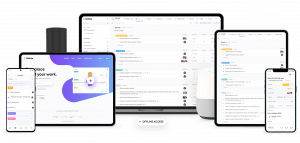
ClickUp is one of the top-rated Agile project management tools in the world. This remote project management tool has everything you need to help your Agile team, whether you use XP, Kanban or Scrum!
Here’s how:
1. Create an epic iteration strategy with Gantt View
An XP team has to do all its programming on a tight schedule.
Otherwise, the project would remain unfinished like the game Half-Life 3, whose development process has been stagnant for more than 10 years!
Gantt View
Fortunately, with ClickUp’s Gantt View, your XP project won’t suffer the same fate as HL3!
Gantt charts visualize tasks that need to be completed in sequence, like aproject timeline!Each task has a start and end date, so your team’s development time isn’t overwhelming.
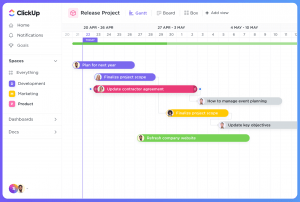
See what you can do with ClickUp Gantt charts:
- Rescheduleautomatically your dependencies every time you make a change
- Viewthe percentage of progressof the project based on tasks completed relative to total tasks
- Determine the critical path , a chain of tasks that is critical to the completion of your project
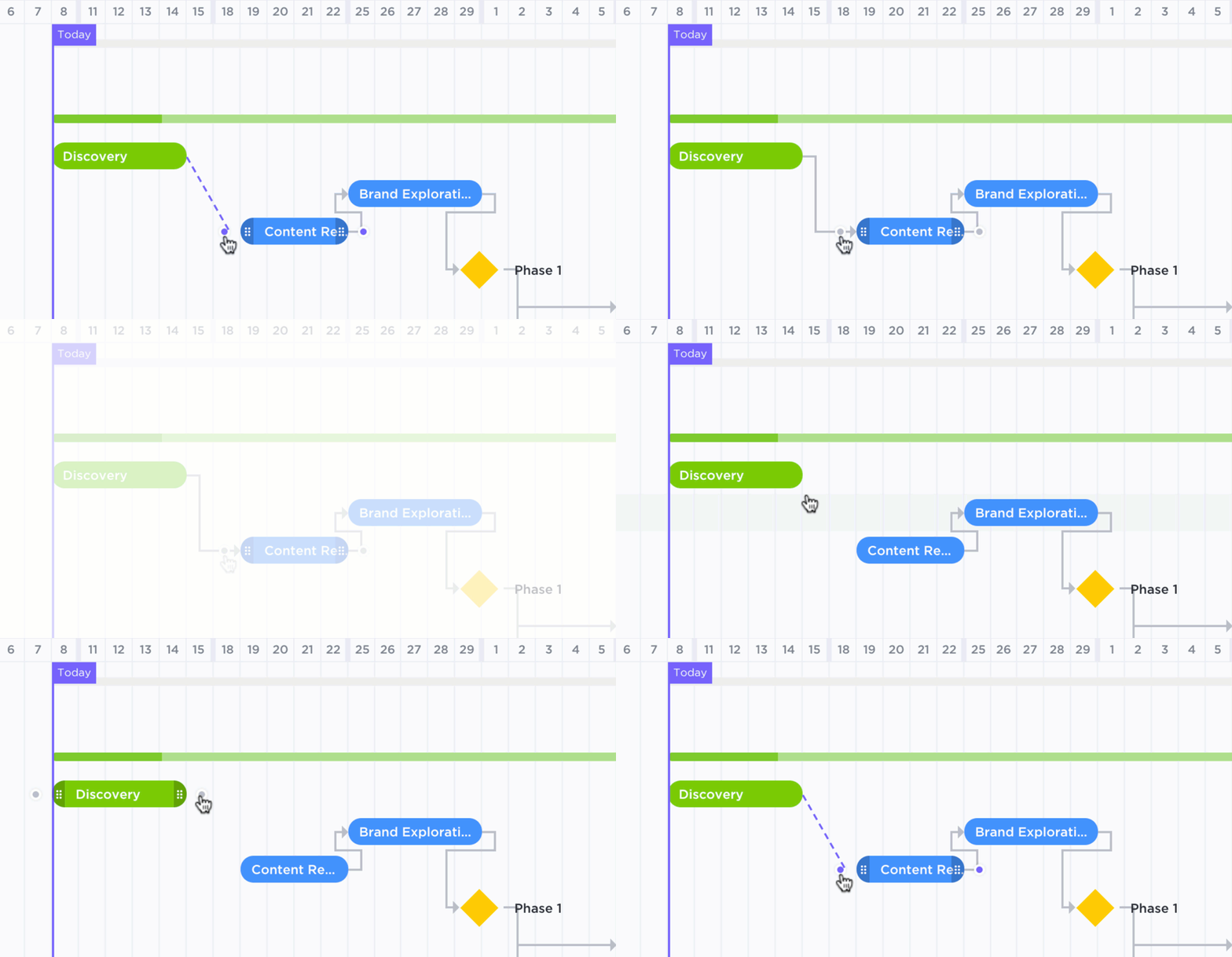
- Createdependent tasksby drawing a line between two tasks as follows:
2. Boost your sprint performance with dashboards
Your XP team needs to be highly motivatedall the time.
And you need numbers to motivate your team to do great work.
Let’s explain:
Video games help players perform better by delivering higher scores.
Similarly, team leaders use agile metrics to motivate their team to perform better.
This is exactly why you need ClickUp Dashboards.
A. Dashboards
ClickUp Dashboards allow you to track your team’s performance at all times!
It is made up of display data from Widgets such as:
- Speed graphs: helps the team find out how many sprint backlog items they can handle in a single sprint
- Burn-up Charts : shows the amount of work remaining on the project
- Burndown Charts : determines whether the team will be able to finish their tasks before the deadline
- Cumulative flow diagrams : reveals hidden bottlenecks in the development process
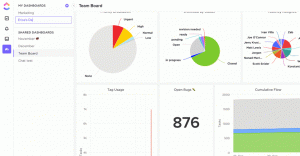
And the best part is which is fully customizable.
So you can track your team’s progressin anyway you choose.
B. Workplace Reports
ClickUp automatically generates Employee Reports, so you don’t have to!
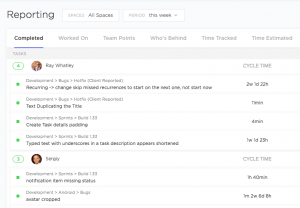
These are useful during design review:
- Task Completed Report: Displays the number of tasks completed by each team member
- Worked On Report:displays the number of tasks each team member was part of
- Who’s behind the report:reveals the team members with the most unfinished tasks
- Time Tracked Report:measures time spent on tasks by each team member
- Workspace Points Report: motivates team members to complete more tasks by rewarding them with points
3. Speed up communication with Comments
An XP team without communication channels is like showing up to a boss fight without any preparation:

Both are doomed to fail!
Extreme programming teams need to collaborate and communicatecontinuouslyto complete your work quickly. Fortunately, every task in ClickUp has a dedicated comments section.
A. Comments
In addition to notifying your team members about something, you can also use comments to domuch more!

Here are some examples:
- Document sharing and files
- Sharing links
- Tagging users
- Mentioning other tasks
- Creating comment threads
Your customers can even even leave effective feedback with assigned comments.
This allows them to convert their feedback into an actionable task for a team member. The team member will be notified about this to ensure they never utter those two infamous words,‘I forgot!’

B. Chat View
Most new video games have an auto-save feature that automatically saves your progress.
Wouldn’t it be cool if the same thing could happen to your comments?
ClickUp automatically saves all your comments, task links, external links and attachments in a handy view!
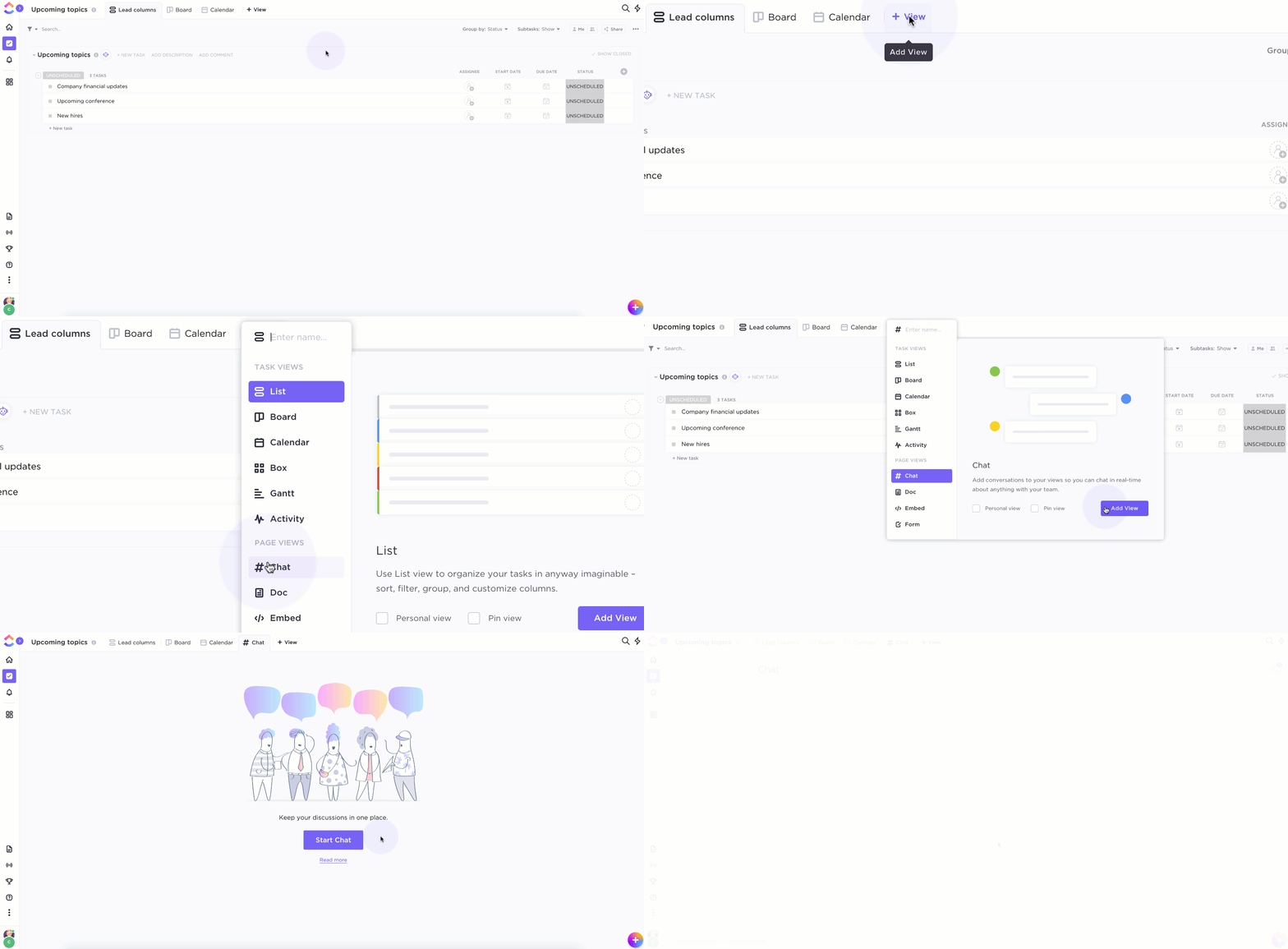
In this view, your Agile team can share codes with each other, with the help of code text formatting!
Additionally, your entire team can also start a dedicated chat thread for a specific project.
Think we’re done?

Here are some more ClickUp features that can be used byanyone, not just by Agile teams:
- Flexible views: Organize your tasks in a checklist, Kanban board or calendar format
- Automations: save tons of time by automating work processes
- Profiles : see what your team members are working on in real time
- Native time tracking: manage your time efficiently for efficient remote project management
- Custom statues: create your own statuses to fit your team’s workflow
Conclusion
Now you don’t have to ask yourself:‘ What is XP in Agile?’
Extreme programming is an Agile methodologyrevolutionarythat can double your team’s development speed!
However, it’s notthateasy to implement.
And using it incorrectly can even make your team less efficient!
But don’t worry.
Agile management software like ClickUp can guide your team on this journey. ClickUp has all the features you need to run a successful Agile project, such as sprint lists, documents and more!
Explore more
Everything TaskUP does with ClickUp, in English.