

Want to learn aboutagile product development?
Whether you’re building software or manufacturing hardware products, the Agile process helps make your development cycle shorter and more productive.
And if you want to learn the basics of the Agile approach, you’re in the right place.
In this article, you will learn what the Agile methodology is, how it works, its benefits, and the best Agile project management tool for you.
Let’s get started!
What is agile ?
The Agile methodology is a set of practices that helps teams reduce the length of the development cycle and create user-centric products.
How does he do this?
AnAgile teamworks inshort sprints2-4 weeks to build a working release of the product.
At the end of each sprint, they present this version to key stakeholders. Based on thefeedbackfrom each stakeholder, they move on to the next sprint.
You repeat this process until the final product meets everyone’s expectations.
Why?
Short sprints help reduce total production time.
And frequent reviews with your stakeholder help you stay in touch with your customer needs.
The result?
A better product designed in less time! developmentbetter productdeveloped in less time!

This is obviously a development style very different from a traditional project management style, such as the Waterfall methodology.
How is the Agile framework different from the Waterfall methodology?
A project Agile contains multiple sprints or development cycles, while the Waterfall methodology has a single production cycle that can last months or even years.
Furthermore, the Agile approachtests products continuouslythroughout the development cycle. Waterfall teams perform product testingonly after it is fully developed.
This means that the customer can evaluate the product only after the production cycle has ended. However, in Agile, you actively involve customers throughout the product development process, helping to create superior products.
Who can use the Agile methodology ?
Although Although the Agile framework was developed for software development projects, this does not mean that the methodology cannot serve hardware development or other industries.
In fact, you can adopt the Agile development methodology for all types of industries, such as finance, marketing, and even construction.
Check out our articles on construction project management software and expert tips on how to be agile.
What is Agile based on?
The Agile Manifesto is a brief document that summarizes what the methodology represents. It establishes a set of 4 values and 12 principles for all Agile development teams.
While these are not hard-and-fast rules that you must follow, the values and principles affect all processes in Agile software development.
Together, the Agile principles and values develop a mindset agile among team members, focused on maximum collaboration and innovation .
The 4 agile values are:
- Individuals and interactionsabout processes and tools
- Functional softwareabout comprehensive documentation
- Customer collaborationinstead of contract negotiation
- Embrace changeinstead of following a plan
The 12 agile principles can be divided into 4 groups:
1. Agile project management principles on customer satisfaction
- Prioritize meeting customer needs to deliver high-quality, functional software on time. agreement
- Accept last-minute changes to requirements
- Keep delivering every two weeks or months to get continuous customer feedback and adapt the product accordingly
2. Agile Project Management Principles on Quality
- Focus on how well your working product satisfies customers to judge its success
- Maintain a steady development pace to keep up with the test-driven development process
- Pay continuous attention to technical excellence and to good design, as this improves your team’s agility
3. Agile Project Management Principles on Collaboration
- Stakeholders and project developers should actively collaborate throughout the development process
- Build projects around motivated team members and give them the support they need
- Participate in conversations face-to-face, as it is the most reliable and efficient way of transmitting information. Encourage team members to communicate directly
- Self-organizing teams that work with minimal supervision provide the best output
4. Agile Project Management Principles on Team Management
- To increase agility, keep your processes simple and eliminate non-essential work
- Assess your team’s performance continually and adjust to become a better, more efficient team
What are the different roles in an agile team?
An Agile project is like a big musical. Sets and costumes can come later.
But to truly succeed, you first need incredible artists.

And the members of the Agile teamfrom the Agile teamare nothing short of artists!
Although they have diverse skills and backgrounds, they all work together to solve the problems at hand. This type of cross-functional collaboration is the foundation of an Agile team’s culture of innovation .
But who are these people and what are their responsibilities?
Here is a list of key Agile team members and what they do.
1. Product Owner
The product owner (sometimes known as the product manager) is where it all starts.
They are the team’s supercomputer: the ultimate source of information about customer needs.
A product owner works closely with users, records their requirements, and translates them into the product backlog. And just like a computer, they are indispensable in all project processes!
2. Project Manager
If the product owner is the source of all customer-related information, the project manager is responsible for making good use of it.
They coordinate the development team to build a product according to the product owner’s guidelines.
Most importantly, they keep an eye on the moving parts of the project cycle, such as sprints and their various stages.
However, if you are following the Scrum methodology, the role of a project manager is shared between the product owner, the Scrum master and development team members.
3. Development Team
The development team is the army on the ground. They are involved in building products in a hands-on way.
Agile development teams are self-organizing, cross-functional teams made up of designers, engineers, programmers, business analysts, etc.
4. Stakeholders
Although project stakeholders do not have an active role in the development process, their input guides the product in the right direction.
The 4 main types of project stakeholders in the Agile methodology are: production
- Main or buyers of the final product
- End users
- Partners who support production
- Insiders such as senior managers or executives
Their needs and vision drive various parts of the product.
What are the various agile product development methods?
The Agile approach is no longer just a product development process.
Over the years, agile practices have come to represent a larger philosophy about production.
The Agile umbrella encompasses a wide range of software and hardware development methods.
But they all share one central goal:develop abetter productin less time!
Typically, an Agile coach or team should have a working knowledge of the fundamentals of the most common Agile software development methods.
Here is a brief look at some variations of the Agile development methodology :
1. Scrum
Scrum is almost entirely like the Agile framework, except for a few key differences.
The most significant difference is the presence of a Scrum master who guides the development team.
In addition, Scrum team members have much more autonomy over their daily operations and work with minimal supervision. However, for this to be successful, they must be experienced enough.
The Scrum framework is best suited for projects that continually evolve.
2. Lean
Toyota pioneered a manufacturing process in the 1970s that focused onreducing all types of waste. This value-driven process, now known asLean, has been adapted to suit any software production.
Lean principles help reduce waste from excessive inventory, overproduction, overworked team members, etc.
Lean is great for streamlining workflows and delivering only what is valuable to the customer.
3. Kanban
Like Lean, Kanban project management is also a Japanese invention. However, it takes a visualvisualapproach to product development.
Teams use a board Kanban to track each task from start to finish. This encourages transparency and improves the team’s ability to identify and address bottlenecks.
4. EXP
Extreme Programming, or XP for short, also shares almost all of the fundamental principles with Agile (as well as Scrum).
However, it has several engineering practices specific to software development, such as testing, refactoring, and pair programming.specific engineering practices for software development, such as testing, refactoring, and pair programming.
XP also focuses on creating consistent project phases for developers, making it an excellent choice for complex projects.
How does agile product development work?
Now you know the basics of Agile.
But you may be wonderinghowthis works on the floor.
Don’t worry. We’ve got you covered.
The typical Agile process is quite simple to understand.
It has only two important phases:
- Planning
- Race
In this section, we’ll cover the nuts and bolts of both and explain how they progress.
To make things fun and simple, we’ll use an example of our own Agile project!
We will try to createa pizza delivery app that brings together the best offers for its users.
Let’s dive into the Agile development process for this project then!
Phase #1: Planning
Your pizza delivery app works to help users save time they would otherwise spend browsing offers and menus.
So why should your project plan waste time?
Effective agile planning focuses mainly on these 4 areas:
A. Product Vision Statement
This is asimple one-line descriptionwhat your product is set to achieve.
Once the project begins, every action you take should trace back to the vision statement .
It must be specific enough torestrict your intention, but wide enough toaccommodate multiple possibilitiesduring production.
Example: Offering people the choice of the best pizzas at the lowest prices.
B. Product Roadmap
The product roadmap highlights all the key features that make a product functional.
You can also add a list of USP (unique selling proposition) features that differentiate your product from market standards.
Example: A feature that allows users to compare prices and delivery times for pizzas between multiple restaurants.
More importantly, because it is a ‘ roadmap ‘, it establishes an approximate production schedule for the team.
C. Product Backlog
A product backlog contains all the items on the Agile roadmap. However, it is notjust a task list.
It is developed and managed by the product owner, who addspriorities and estimatesto each resource in it.
Additionally, product backlog items are assigned to the development team based on their priority.
However, the product backlog is not frozen in time.
Whenever the product owner gains new insight into customer behavior, the backlog can also change to adapt and meet customer needs.
D. Release plan
After planning your backlog, you can define a release plan for different sets of features that will be developed over multiple sprints. The output of each sprint is known as an ‘increment’.
Phase #2: Sprints
If the planning stage is like writing a movie script, sprints are when you shoot it!

All production activity takes place in sprints that last between 2 and 4 weeks.
It is also the phase in which testing, reviews and changes take placetesting, reviews and changes.
This makes sprints the longest, most resource-intensive and most productive part of the Agile product development process.
See how a sprint cycle of the Agile product management process is conducted: A. Sprint Planning a sprint cycle of the Agile product management process is conducted:
A. Sprint Planning
The release plan narrows down the broader agenda for each sprint. For example, the product backlog mentions that the integration process is a priority. and needs to be completed in the first sprint.
But it’s only in the sprint planning session that the team decides as reach it.
For example, the product backlog mentions that the integration process is a priority and needs to be completed in the first sprint.
At the first sprint planning meeting, the team will decide which tasks and subtasks are needed. This list is called sprint backlog .
The tasks mentioned in the sprint backlog are then assigned to team members along with specific goals and deadlines.
In short, the sprint planning process establishes a path for the sprint.
All your team needs to do now is work on it.
B. Daily Standup
Agile values insist on face-to-face interactions for better coordination.
Especially when work is in full swing during sprints.
Daily stand up is a way to improve this communication.
In it, the development team meets for15 minutes every morningto discuss the previous day, plan for the next day, and any potential obstacles in their path.
These daily meetings are short enough toavoid prolonged discussions, but long enough toshare the highlights of the day .
And just like a good pizza, a slice of it can fill you up!
C. Sprint Review
After weeks of working at a feverish pace to finish the sprint backlog, the team delivers an Increment. The team presents this working software to key stakeholders at the sprint review meeting.
This is an opportunity for the team to evaluate live user feedback and identify changes that need to be made.
At this stage, your product is like a pizza base with some sauce and toppings.
If the ingredients are right, a little heat (or feedback) will just make it abetter product!
D. Sprint Retrospective
An agile team focuses on improving with each sprint.
That’s why after the review, before entering the next sprint,they take a breakto conduct a retrospective.
This meeting is an internal review of what worked and what didn’t in the previous sprint.
The team uses this information to improve in the next sprint.
And with each version of working software they get closer to the final product.
The 3 main benefits of agile product development
Now you understand how the Agile method is different from traditional production practices.
But why shoulduse it?use it?
Here are the top 3 benefits of going agile:
1. Faster communication and better informed stakeholders
Poor communication is one of the biggest reasons for project failure.
But the Agile process protects against this by putting communication in theproject center.
- Team members interact with each other every day in their daily meetings
- The product owner, as the customer’s representative, is part of all processes
- Reviews after each sprint encourage direct participation from stakeholders in the production process
And throughout the project, teams rely more on face-to-face interaction than any other type.
It really is the fastest way to get things done!
2. Develop an innovative environment
Can you expect team members to be innovative if you also require them to write tedious documents and report to a dozen people?
Agile creators have recognized how too many processes discourage innovation.
And it is That’s why agile principles are clear about what the team’s priorities should be.
An agile team focuses on deliveringworking software in multiple iterations.
While traditional methods focus on achieving perfection all at once, Agile emphasizes one of ‘trying and improving’ . This is why the Agile environment is a powerhouse of design thinking and creativity.
3. Faster production cycles
Here’s a horror story for a developer:
Working on a product formonthson end only to realize it doesn’t meet expectations from theclient!
Yes, it’s the stuff of nightmares.
It will take you back to the stone ages of your project!
Fortunately, in an Agile project, you can maintain a constant pace of productionandrevisions.
Customer collaboration will provide user feedback during the production and testing phases.
Furthermore, as the sprint duration is limited to 2-4 weeks, there is a natural barrier to any delay in the product development process.
If you want to know more about the benefits of agile software development, our team has compiled 6 more reasons in this post.
All of this will keep you on track to develop a market-ready product.
But hey, all these advantages don’t make building a product any easier.
You still have many problems to solve, such as:
- How can you make a team communicate effortlessly with each other and with stakeholders?
- How do you keep up with your team’s agility?
- How can you keep up with the breakneck pace and hundreds of sprint activities?
Dozens of questions. Unique solution.
You need a powerfulproject management tool.
And not just any tool; you need the best on the market,ClickUp.
The best agile project management tool of 2021: ClickUp
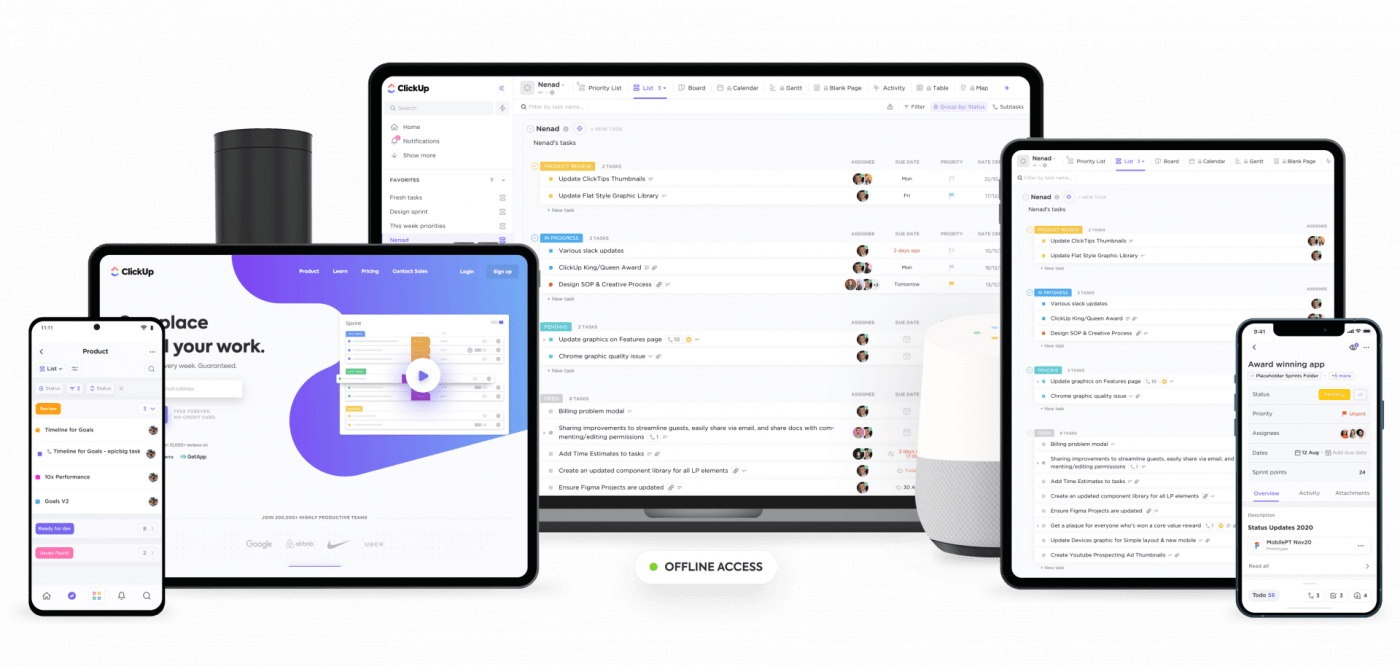
With a wide range of Agile product development and collaboration features, ClickUp has all to support any Agile team (internal and remote )!
See how some ClickUp features support the Agile product development process :
A. Manage sprints with Sprint Lists and Sprint Points
Sprints are the longest phases in the Agile development process, each a minefield of fast-paced activities.

Of course, you can’t miss a single piece of information.
But how can you manage sprints without extensive documentation?
Just use ClickUp’s Sprint Listsfeature.
These are simple checklists that break down each sprint into small tasks. You can check tasks off the list as you progress through the product roadmap .
You can create a checklist for all your Agile projects, tasks, subtasks, and even your user stories. Add Scrum points to a list to find out how long it will take you to complete backlog items.

But that’s not all.
You can’t manage a sprint without some sprint points attached to it, right?
To help you monitor your workload capacity, ClickUp lets you add Sprint points for efficient resource management. This is especially useful when you are using the Timeline view to organize your schedule.
How?
Because you can easily add Sprint Points to your tasks, you can better determine everyone’s capacity for better work allocation.

And if that’s not helpful enough, ClickUp lets you choose your own points system. Whether you prefer the Fibonacci sequence (1,2,3,5,8), the linear number system (1,2,4,8) or something else – ClickUp can handle it!
B. Get a complete overview of projects in the dashboards
Whether your Agile team works remotely or in the same office, they need to stay on top of their projects.
The ClickUp featureDashboardmeets this need.
It will provide quick visual summaries of your entire project to ensure everything is running smoothly.
Plus, you can even customize your dashboard with sprint widgets such as:
- Burndown Charts : the amount of work remaining on a project
- Burnup Charts : the amount of work already completed on a project
- Velocity charts : task completion rate
- Cumulative flowcharts : task progress over time

C. Communicate effortlessly in the comments section
Agile replaces long, aimless meetings with quick, condensed updates.
And ClickUp encourages fast, clean communication between teams with itscomments section.
Use it to:
- Detailed conversations:about a specific task, activity or assignment
- Tagging team members:to alert them to important comments
- Document and file sharing:project-related
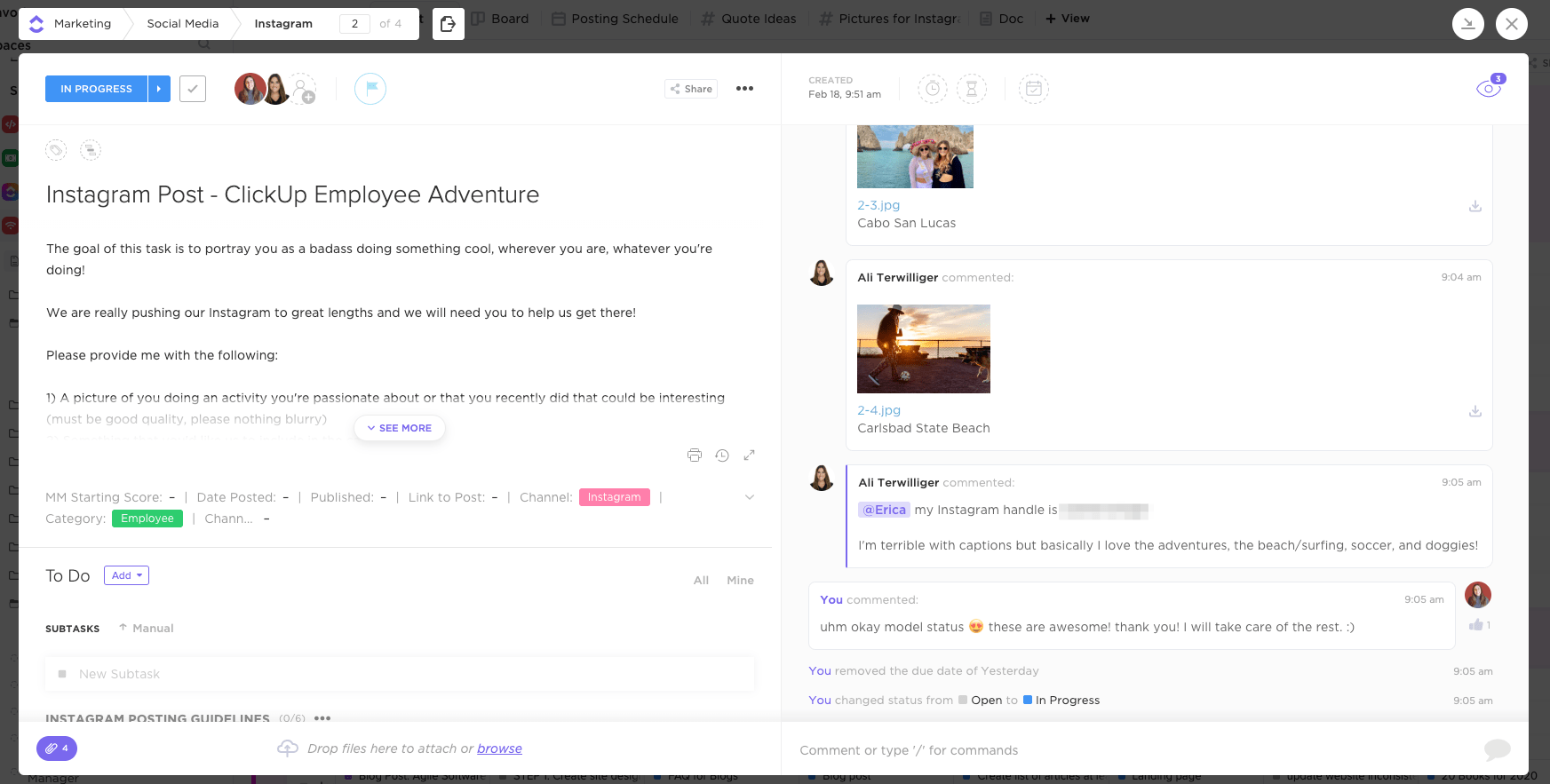
But you’re worried that the sea of bug fix feedback will overwhelm theproduct team?
Don’t worry, the feature of assigned comments from ClickUp is at your disposal.
Convert any comment into a task and assign it to yourself or another team member. ClickUp notifies the team member and shows the comment in the Home tab of their inbox so they don’t miss it.
Once they finish the task, they can simply resolve the comment to indicate task completion.

D. Inviting stakeholders to collaborate with customized access rights
Regular customer collaboration makes the Agile method unique.
And ClickUp’s Custom Access Rightsfeature allows this.
The feature helps an Agile product manager to share their project files, folders, and task lists with anyone outside their workspace.
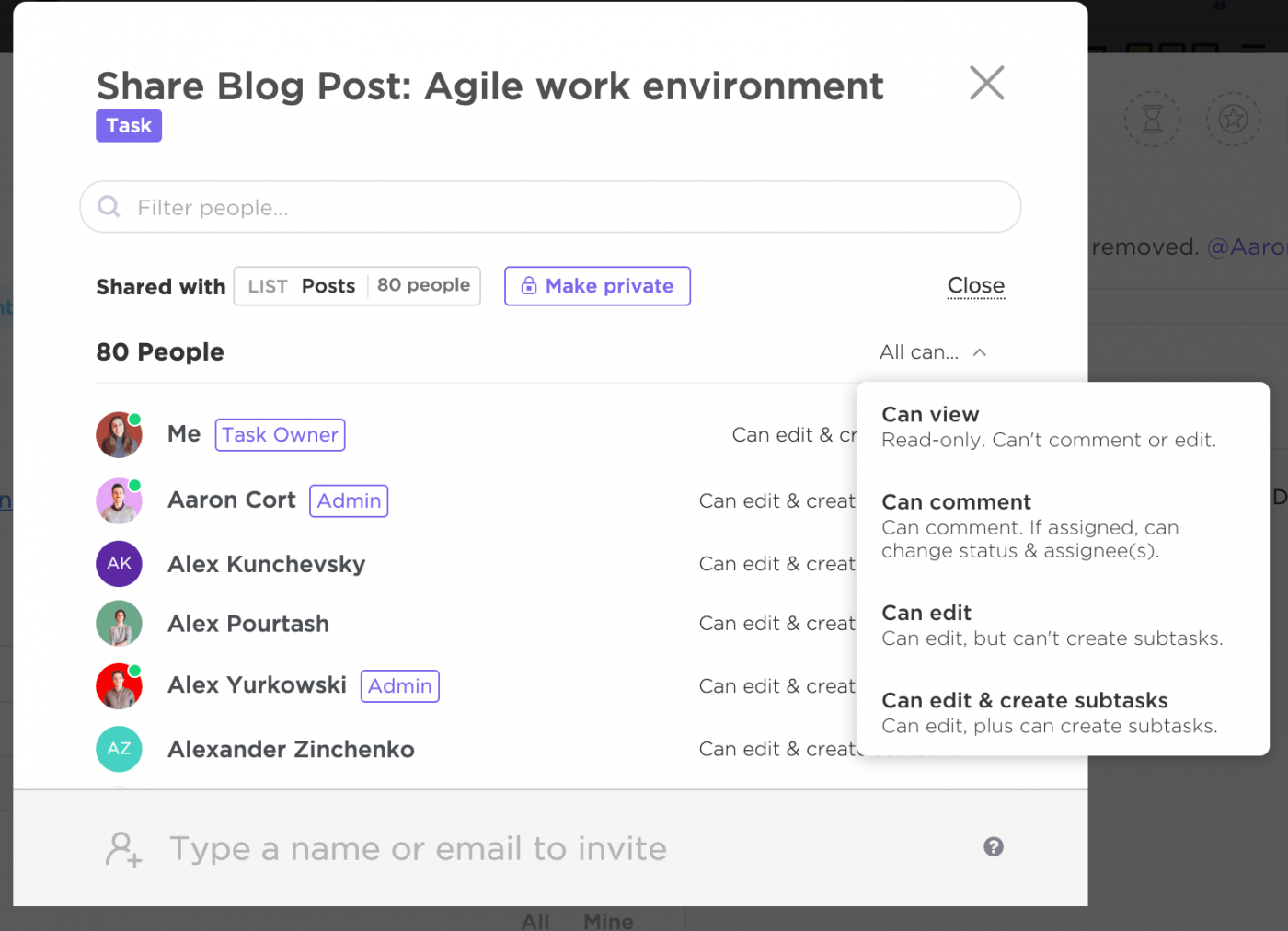
But you still maintain full control over which ‘ permissions’ are granted to the interested party.
Some examples of permissions are:
- Can view: to view project details but not interact
- Can comment: to comment on tasks and task lists
- Can edit: to edit tasks, but not create them
- Create and edit: to create your own tasks and subtasks
- Can delete: to delete tasks that have not been created
But that’s not all.
ClickUp offers an incredible range of project management features to assist with agile transformation such as:
- Goals: Break down your sprint goals into easier-to-achieve goals
- Priorities: Try the most important tasks first
- Multiple Views: Choose from multiple project views such as List View, Board View, Box View, Calendar View, and Me Mode
- Weekly Scorecards : Track your developer team’s objectives and goal progress at a glance
- Pulse: know which tasks your remote or internal team is most active in during a period
- Automation : Automate 50+ repetitive project processes to save time
- Gantt Charts : Get a complete overview of your project timeline at a glance
- Chat view : Easily access all your project-related conversations
- Powerful iOS and Android mobile apps : for work collaboration on the go
Conclusion
An agile product development process will take your organization’s productivity to the next level.
Not only will you develop more user-centric products, but you will also spend less time and resources in the process.
But to adapt to the Agile method (and keep up with it), you’ll need the right technology to support it.
So why not sign up to ClickUp today?
ClickUp is designed especially for agile teams and focuses on unlocking their potential.
From sprint lists to detailed reports, it has everything you need.
Explore more
Everything TaskUP does with ClickUp, in English.