
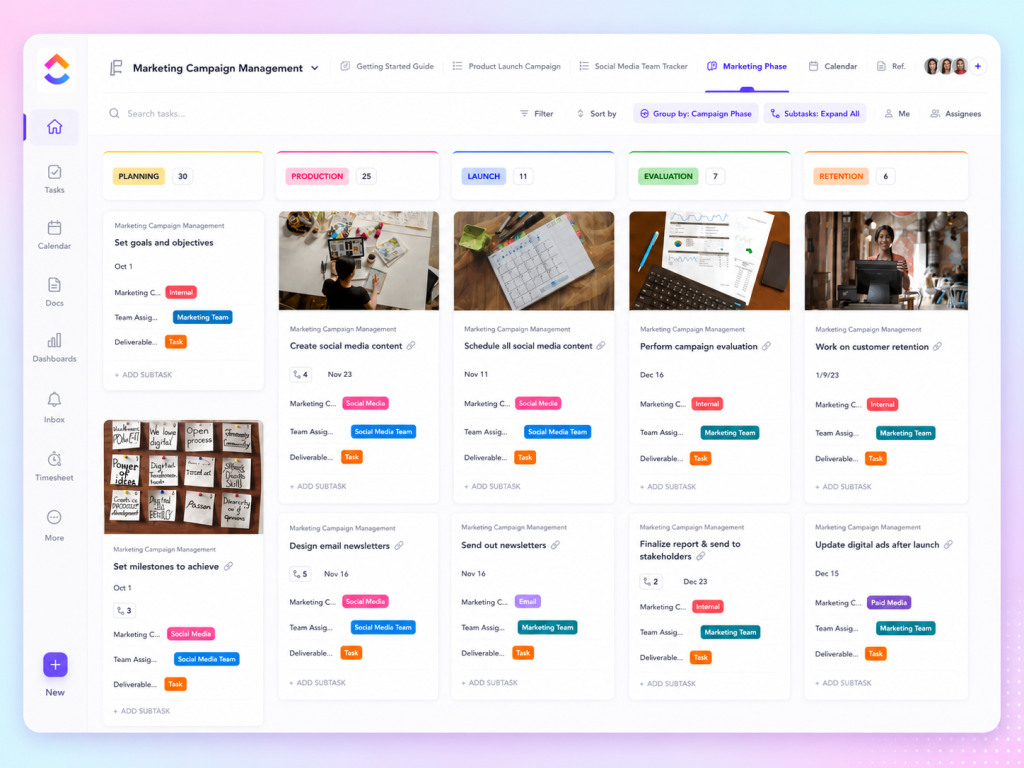
ClickUp for marketing teams is an approach that centralizes tasks, project views and knowledge resources on a single platform, facilitating organization and automation of marketing routines. This positioning allows teams to align deliveries, track deadlines and use tools such as boards, Gantt and collaborative documents to support campaigns and operations.
The combined use of resources mentioned in the product topics — such as Tasks, Board views, Gantt charts, Docs and AI & Automation — creates an environment where planning, execution and governance converge. Marketing teams can structure projects into sprints, organize backlog into roadmaps and maintain centralized knowledge in Docs/Wikis, reducing rework and improving visibility of progress.
How ClickUp for marketing teams improves organization
Organization for marketing teams depends on clarity about priorities, visibility of deadlines and access to relevant information. Task management tools and varied visualizations (such as Board views and Gantt charts) allow you to map campaigns, sequence deliverables and identify dependencies between activities. Dedicated spaces for projects and portfolios make it possible to group initiatives by product, channel or quarter, while Docs and Wikis serve as a central repository of strategies, briefings and guidelines.
In addition, Roadmap & backlog and Sprints features help transform marketing objectives into measurable deliverables. Sprint reports and tracking dashboards support coordination meetings and reviews, maintaining governance over priorities and deadlines.
Automation, AI and operations: reduce manual work
Automation and AI integrate repetitive actions and support operational decisions. Features listed as AI & Automation and Ask AI allow you to automate approval flows, notifications and status updates, freeing the team for activities of greater strategic value. Native integrations with other tools and templates for tasks and processes accelerate the standardization of campaigns and recurring operations.
For marketing operations, it is important to define clear automation triggers and rules — for example, status transitions between stages of a content funnel or automatic assignment of people responsible for tasks based on pre-defined criteria. This reduces human errors and ensures consistency in execution.
Views, governance and knowledge management
Various views (Board, Gantt, lists, Roadmap) are essential to adapt the visualization of work according to the function: managers monitor portfolios and deadlines on Gantt charts; creatives and producers prefer Board views or Kanban for activity flow; analysts consult reports and metrics. Governance involves defining spaces, permissions and documentation standards in Docs and Wikis, ensuring that brand standards and processes are accessible and updated.
A practical aspect of governance is standardizing templates and folder structures for campaigns, landing pages and content assets. This facilitates auditing, handoff between teams and backlog maintenance.
The following table summarizes relevant functionalities found in the ecosystem and a direct description of what they represent, focusing on terms that help marketing teams choose how to structure work and knowledge.
| Functionality | What it is / how help |
|---|---|
| Tasks | Manage tasks and responsibilities in each project |
| Board views | Kanban-style view for workflow |
| Gantt charts | Visual planning of schedules and dependencies |
| Docs and Wikis | Collaborative knowledge hub and documentation |
| AI & Automation / Ask AI | Automation capabilities and AI support to speed up tasks |
| Sprints and Sprint reports | Iterative delivery management and progress tracking |
| Roadmap & backlog | Organization of priorities and medium-term vision |
In addition to the table that describes functionalities, concrete practices facilitate implementation and adoption by marketing teams. The list below presents complementary and operational actions that do not repeat the content of the table, focused on process and routine.
- Define spaces and projects by macro-initiative (campaign, channel or quarter) to segment work.
- Create templates for briefings, content calendars and publication checklists, ensuring consistency.
- Use different views depending on function (Gantt for planning, Board for execution and list for daily monitoring).
- Standardize task naming and custom fields to facilitate filters and reports.
- Document processes and guidelines in Docs/Wikis and maintain an index or summary for access fast.
Measure adoption and adjust governance
Maintaining practical governance involves monitoring the adoption of processes and adjusting as necessary. Simple measures include periodically reviewing templates, auditing permissions and updating the roadmap backlog. Sprint reports and portfolio dashboards help identify bottlenecks and areas that need automation or resource reallocation.
When your team consolidates governance and automation routines, it becomes simpler to scale campaigns, replicate processes across products, and maintain organized history for future analysis.
ClickUp for marketing teams provides a set of features that, when combined coherently, support organization, automation and governance. Structuring spaces, taking advantage of appropriate views, standardizing templates and applying automation reduces repetitive tasks and improves work visibility. To deepen implementation and find practical models adapted to the marketing flow, consulting available resources and templates can accelerate adoption.
More information and complementary materials are available at https://taskup.com.br/
Explore more
Everything TaskUP does with ClickUp, in English.