
Introduction
Brain² Updates on ClickUp attract attention with a very direct promise: not only to respond better, but to help complete real work. For those who use AI on a daily basis, this matters because the difference between an interesting novelty and a useful improvement is in the execution, not in the speech.
From what was presented in the changelog, Brain² starts to improve itself, directing each request to the most appropriate models and advancing in tasks with more autonomy. In practical terms, the correct reading is this: the experience tends to become less manual, more efficient and closer to an assistant who best decides how to help.
Brain² updates: what was really announced
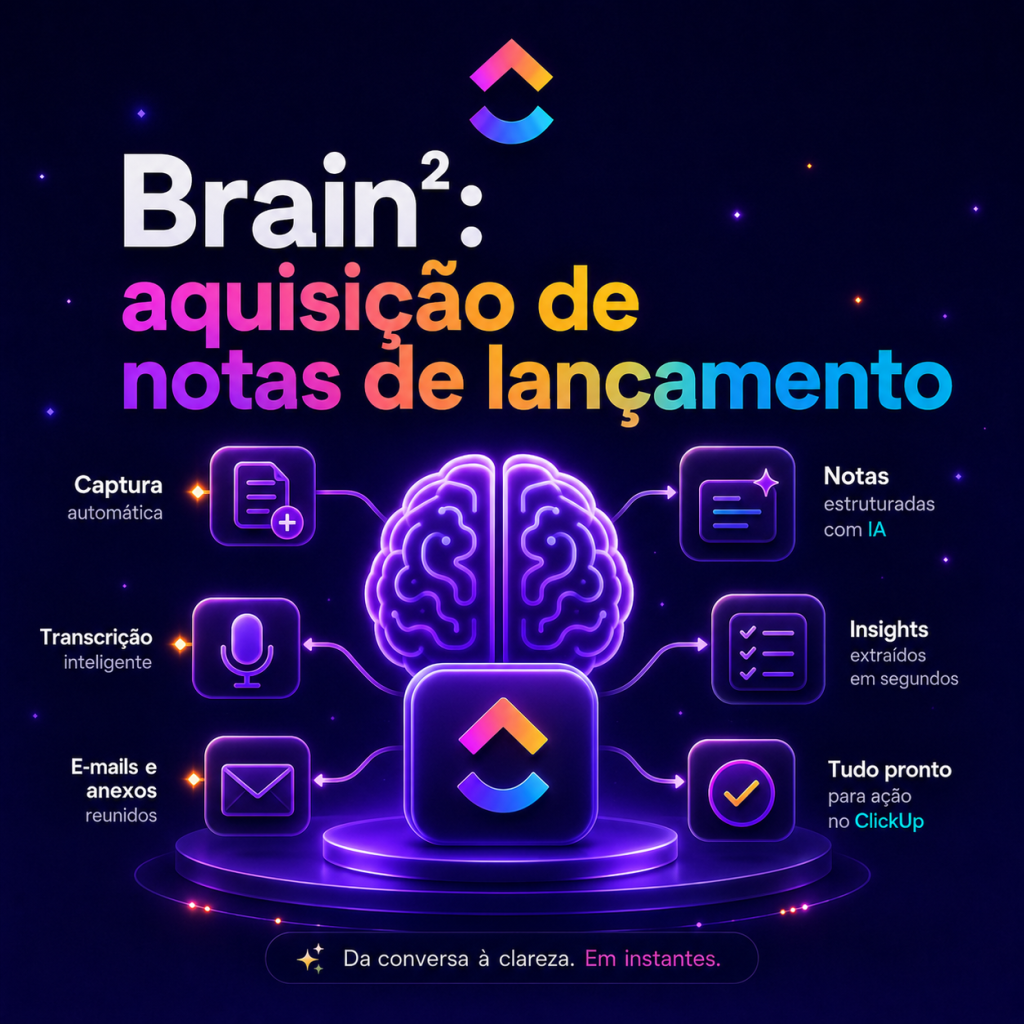
The announcement focuses the message on three fronts. The first is self-improvement, indicating that Brain² improves its own performance. The second is routing to the best models, which suggests a smarter decision layer behind each order. The third is the most relevant for the end user: the ability to actually complete parts of the work, and not just generate text or loose ideas.
This set changes the way the product is read. Instead of AI treated as a single, static tool, Brain² appears as a system that tries to better choose how to respond and act. This tends to reduce a common problem in AI platforms: the user even receives help, but still needs to redo, adapt or decide everything themselves.
Where these updates can generate real gains
The most obvious gain is in flows with many small decisions. Summarizing information, organizing context, suggesting next steps and forwarding requests to the most appropriate model are improvements that save accumulated time. In teams that work with tasks, documents and internal communication, a few minutes saved per interaction turn into hours throughout the week.
There is also a consistency effect. When the system better chooses how to handle each type of request, the experience tends to be less irregular. This does not mean automatic perfection. It means less trial and error to arrive at a useful answer, especially in scenarios where speed and context matter as much as creativity.
How to Evaluate These Updates Without Getting Carried Away
A good release note isn’t just the one that sounds ambitious; This is what is proven in use. The simplest criterion is to observe whether Brain² reduces real steps. Do you need to write longer prompts than before or shorter ones? Does the response arrive more ready to use? Does the system help you decide which path to follow or does it continue to require mediation all the time?
Another point is to separate demonstration quality from operational quality. In presentation, almost all AI appears fluid. In everyday life, the important test is different: does it maintain context, choose the type of response well and deliver something usable in common tasks? If the promise is to complete work, the parameter must be work completed with less rework.
Signs that the new feature makes sense for your routine
It is worth paying attention to simple indicators. If your team spends a lot of time switching between research, synthesis, writing, and organization, better template routing can make a difference. If the bottleneck is transforming information into action, the execution part tends to be more important than the generation part.
On the other hand, if the use of AI is still sporadic or poorly integrated into the operation, the impact may seem smaller at first. In these cases, the best way is to test in short processes, with a clear beginning, middle and end. The question is not whether Brain² impresses. The right question is whether it takes manual work out of the way without creating new friction.
Key Points
- Brain² was touted as a more execution-oriented evolution than simple response generation.
- Routing to better models suggests smarter decisions by request type.
- The real value of updates appears when there is less rework, less manual adjustment and more tasks moving forward.
- The best way to evaluate newness is to measure practical gains in recurring team flows.
How to put it into practice
- Choose a frequent task, such as summarizing meetings, structure documentation or organize demands.
- Test Brain² in the same flow for a few days and compare with the previous process.
- Observe time spent, need for manual adjustments and clarity of deliveries.
- Record where AI really accelerates and where it still requires supervision intense.
- Decide adoption based on operational gain, not just initial impression.
How to read the impact of Brain² in practice
| Appearance | Before upgrading | With Brain² |
|---|---|---|
| Choose model | More dependent on configuration or trial | Smarter routing per request |
| Quality of help | Good for ideas, not always for execution | More focus on completing parts of the work |
| Operational speed | User does more manual mediation | Flow tends to become more direct |
| Adoption in time | Specific and experimental use | Potential for use more incorporated into routine |
Conclusion
The Brain² announcement points to an important change: useful AI is not just the one that responds well, but the one that chooses better how to respond and helps get the job done.
If Updates deliver this in real-world use, the gain could be relevant for teams dealing with volume, context, and quick decisions. The best next step is simple: test in concrete processes and measure how much the promise turns into a result.
Next step
Do you want to turn this news into real gain? Choose a simple process, test Brain² thoughtfully, and move to the next step based on results, not promises.
FAQs
What was highlighted in Brain² updates on ClickUp?
The changelog highlights three core ideas: self-improvement, routing to the best models, and increased ability to complete work in practice.
Do these updates mean that Brain² does everything itself?
No. The more balanced reading is that it tends to reduce manual steps and better decide how to help. Still, the value depends on the type of task and the supervision required in each case.
How do I know if Brain² is worth it for my team?
Test on repetitive flows and compare time, quality of delivery and need for correction. If there is less rework and more real advancement of tasks, the update makes sense.
What is the main criterion for evaluating this new development?
Operational result. More than a pretty answer, the point is to see if AI helps you complete activities with less effort, less context switching and more consistency.
Explore more
Everything TaskUP does with ClickUp, in English.