
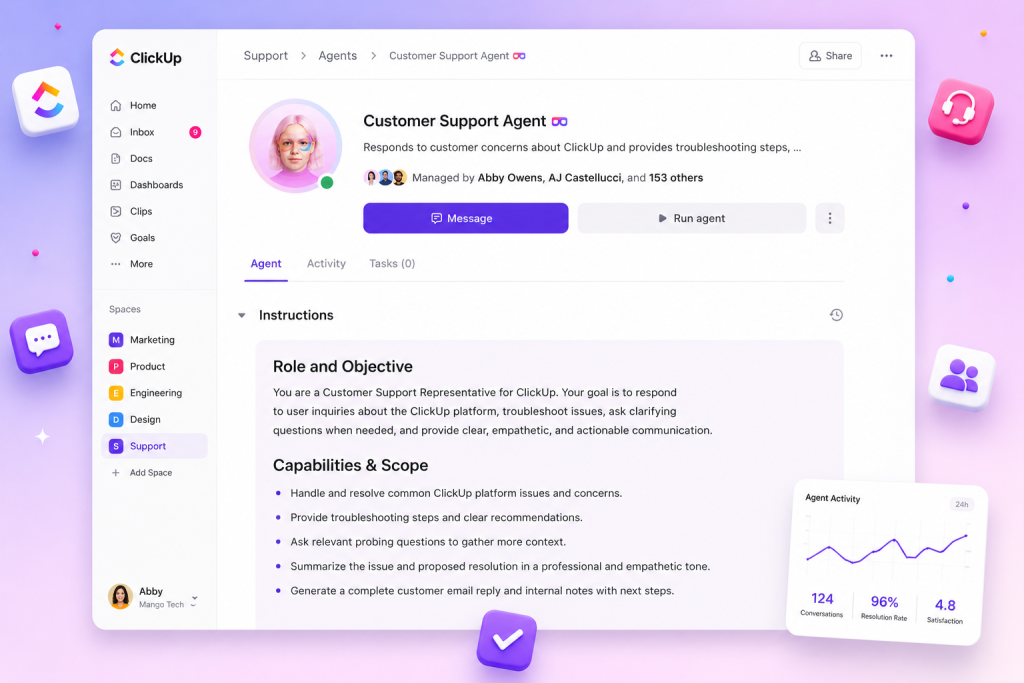
AI in customer service is an approach that integrates artificial intelligence and automation into support flows to make problem resolution, routing, and information access faster and more consistent. Implemented in conjunction with task management tools, knowledge bases and operation panels, AI in customer service helps standardize responses and direct requests within an organized work environment.
To act in a practical way, the integration between resources such as tasks, views (Kanban, Gantt), documents and automations creates an ecosystem in which requests enter as trackable items, knowledge is centralized in wikis or docs, and rules Automated systems perform routing or status updates. This structure reduces rework and facilitates coordination between support teams, operations, and customer-facing teams.
AI in customer service: principles and benefits
The core principles for applying AI in customer service include centralizing information, automatically categorizing requests, and executing repetitive actions through automations. Centralizing tasks and knowledge in a single space allows agents to access history and contexts without exchanging tools. Automatic categorization and prioritization reduces triage time, while automations free up agents for cases that require human judgment.
How to Structure Support Workflows with Automation and Knowledge
An effective support workflow combines standardized inputs, automation rules, and a knowledge repository. Entries can be created as tasks or tickets with fields that capture priority, request type, and customer; automated rules move these tasks between views (e.g. Kanban or lists) according to predefined conditions; and centralized documents serve as a reference for responses and procedures.
The use of sprint reports and operational dashboards helps to visualize bottlenecks and resolution times, while integrations with CRM and other data sources make it possible to complete the service context before executing automated actions. Universal search tools make it faster to find policies, scripts and customer history, reducing mean time to resolution.
Metrics, operations and governance for AI-driven fulfillment
Monitoring operational metrics is essential to validating automations and improvements with AI. Indicators such as ticket volume, triage time, reopening rate and compliance with service level agreements (SLAs) inform adjustments to automated rules and response templates. Governance involves defining those responsible for updating the knowledge base, reviewing automations and auditing automated decisions to avoid process drift.
A table helps relate management and automation resources to typical customer service applications and facilitates implementation prioritization.
| Resource | Application in fulfillment |
|---|---|
| Tasks | Record requests, assign responsible and track progress |
| Views (Kanban, Gantt, Portfolios) | Organize workflow, visualize dependencies and prioritize deliverables |
| Docs / Wikis | Centralize procedures, fulfillment scripts, and knowledge bases |
| AI & Automation | Automate triage, routing, and status updates across tasks |
| Universal Search | Quickly find customer-related information and history |
| CRM (integration) | Enrich tickets with customer data and sales or support context |
| Reports and Sprint Reports | Monitor operation performance and identify points for improvement |
In addition to the table, a practical checklist helps to operationalize AI projects in customer service, with distinct steps that do not repeat the items in the previous table.
- Map service journeys to identify points that can be automated.
- Define minimum fields on request forms for efficient triage.
- Standardize response templates and procedures in the knowledge base.
- Configure rules that move tasks across phases with clear triggers.
- Establish responsibilities for document maintenance and automations.
- Periodically review automatic rules based on operational reports.
Best practices for scalable adoption
For AI in customer service to be scalable, starting with simple and measurable automations is recommended. Prioritizing high volume or low complexity cases allows for quick wins and validation of flows. Always documenting automation decisions and maintaining a single source of truth for policies prevents inconsistencies between human agents and automated routines.
Common risks and how to mitigate them
Risks include misconfigured automations that route incorrectly or outdated answers in the knowledge base. Practical mitigations involve testing in a controlled environment, human approval at critical points in the flow, and regular audits of rules and documents. Periodic reports point out where automations fail and which content needs updating.
Adopting AI in customer service requires a combination of work organization, knowledge centralization and operational governance to maintain consistency. By applying task management principles, clear visualizations, reference documents and gradual automations, it is possible to reduce support friction and safely scale processes.
Explore more
Everything TaskUP does with ClickUp, in English.