
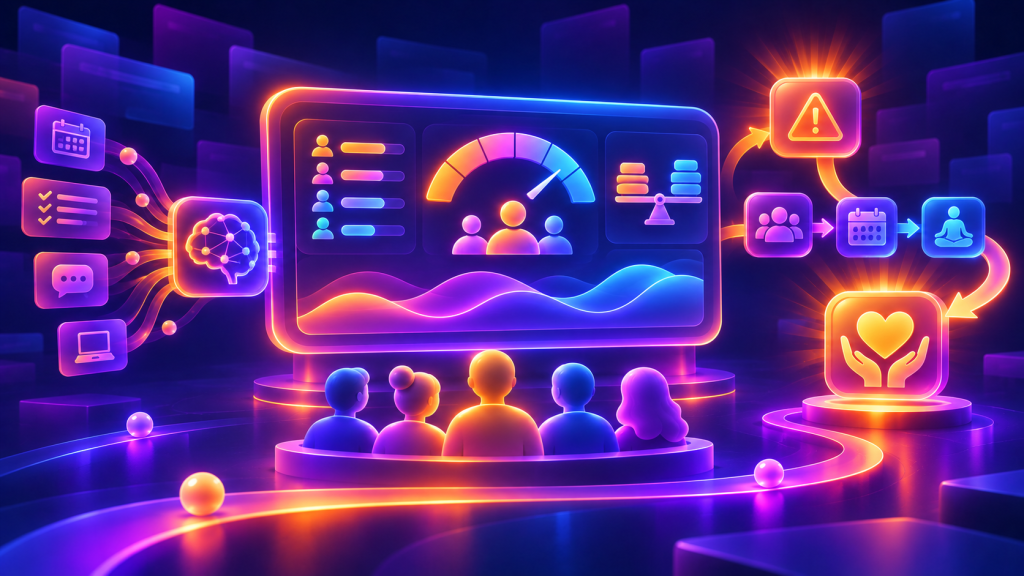
AI and Team Health: Detect Risks Without Surveillance
Work data can reveal overload, blockers, and declining collaboration before they become missed deadlines or attrition. The boundary is clear: support the team, never surveil individuals.
What you will learn
- Which operational signals are useful and ethical.
- How to separate work health from personal diagnosis.
- How AI can summarize patterns without creating surveillance.
- What leaders should do after detecting risk.
Why this matters now
Ai and team health has become urgent because growth increases volume, dependencies, and coordination cost. Without a shared system, teams compensate with messages, meetings, and individual effort. That may work temporarily, but it does not scale.
The answer is not enabling every available feature. It is defining a minimum viable flow, reliable data, ownership, and metrics. Technology should reduce friction and improve decisions—not digitize existing confusion.
How to apply it in practice
Stage 1
Define purpose, transparency, access, and retention before analyzing data.
Practical decision: Define purpose, transparency, access, and retention before analyzing data. Evidence of success: recurring overload.
Stage 2
Observe workload, overtime, blockers, rework, and collaboration distribution.
Practical decision: Observe workload, overtime, blockers, rework, and collaboration distribution. Evidence of success: blocked time.
Stage 3
Analyze team trends, never medical conclusions or individual judgments.
Practical decision: Analyze team trends, never medical conclusions or individual judgments. Evidence of success: rework.
Stage 4
Combine quantitative signals with human conversation and safe listening.
Practical decision: Combine quantitative signals with human conversation and safe listening. Evidence of success: workload distribution.
Stage 5
Turn alerts into capacity, priority, process, and support changes.
Practical decision: Turn alerts into capacity, priority, process, and support changes. Evidence of success: retrospective participation.
Metrics to monitor
- Recurring overload— track the trend, variance, and associated management action.
- Blocked time— track the trend, variance, and associated management action.
- Rework— track the trend, variance, and associated management action.
- Workload distribution— track the trend, variance, and associated management action.
- Retrospective participation— track the trend, variance, and associated management action.
Mistakes that reduce results
30-day action plan
Week 1 — Diagnose
Map the current process, baseline, and major risks.
Week 2 — Design
Configure a simple flow, required data, owners, and success criteria.
Week 3 — Pilot
Test with real users, track exceptions, and compare early metrics.
Week 4 — Govern
Remove friction, document the standard, train by role, and schedule reviews.
Why ClickUp is the strongest foundation for this evolution
Want to turn this concept into a real ClickUp operation?
TaskUP analyzes your process, identifies bottlenecks, and designs a ClickUp architecture with automations, metrics, and governance.
Request a process assessment →Keep improving your operation
Frequently asked questions
Can AI measure morale accurately?
It can identify signals and trends, not individual feelings or diagnoses.
Which data should we use?
Prefer flow, workload, and blocker metadata with transparency and minimization.
What should an alert trigger?
A conversation, context validation, and better work conditions before any performance judgment.
Sources and methodology
Original TaskUP article based on research from official ClickUp content and practical operations design experience. The reference material was interpreted and expanded; this is not a translation of the original article.
Explore more
Everything TaskUP does with ClickUp, in English.