
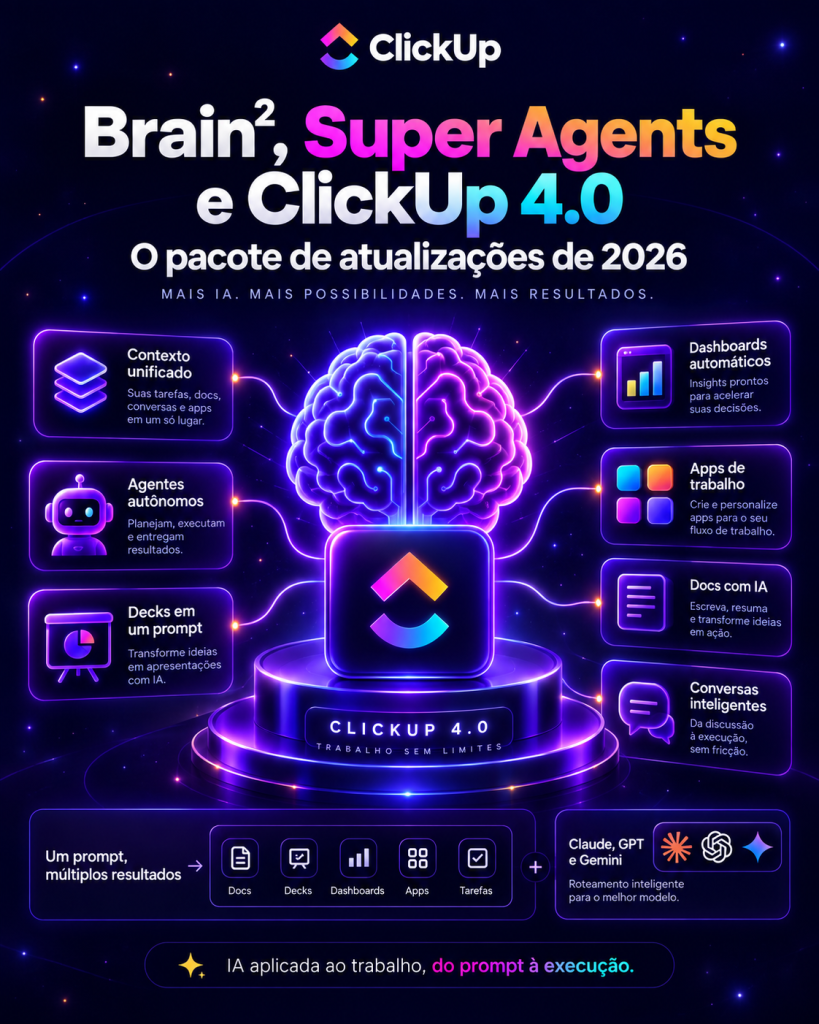
ClickUp 2026 updates introduce substantial changes to the way teams manage work, automate processes and apply AI to day-to-day operations. The launch of Brain2 and the arrival of Super Agents are the most notable milestones, accompanied by interface upgrades, native automations and new pricing options that impact adoption and governance.
The context of these updates shows a clear movement: deep integration between work context (tasks, Docs, decisions and conversations) and AI models, as well as tools that take manual work out of the routine (such as native automations with Google Drive and agents that run complete flows). In the following sections, there are practical explanations of each change, implications for operations, and suggested steps to manage cost and security risks without resorting to external assumptions.
Key Technology and Feature Updates
The 2026 update package focuses on three fronts: a new AI core (Brain2), autonomous agents within the workspace (Super Agents), and an overhaul of the platform experience (ClickUp 4.0 already consolidated). Brain2 replaces the original Brain with a platform that aggregates context of tasks, Docs, decisions and conversations and routes queries to Claude, GPT or Gemini depending on the type of demand. Among the announced capabilities is the automatic generation of slide decks, dashboards and work applications from a single prompt.
Super Agents arrive as AI “colleagues” that can be mentioned in comments, assigned to tasks and triggered in flows. They cover end-to-end activities—from email management and meeting scheduling to reporting and imaging—with real-time audit trails and granular permissions to control access. Complementing this, Brain MAX was launched as a standalone mobile app for interacting with Brain2 outside of the main workspace, bringing the same work context to iOS and Android.
Strategic impacts — ClickUp 2026 updates
2026 updates shift priorities for operations, governance, and AI adoption across teams. From an operational perspective, native automations (e.g. automatically creating folders and Docs in Google Drive when tasks are created) reduce points of failure and middleware dependency. For governance, tools such as the AI credit usage dashboard and audit trails for agents allow visibility and control over consumption and responsibilities. In terms of product, consolidation to the 4.0 interface means that all teams start to work on the same convergent navigation, with a direct impact on training and process standardization. A workspace with built-in AI requires decisions at three levels: technical and policy configuration, cost assessment, and process review. Organizations need to balance the productivity gain with the new layer of costs associated with Everything AI and the Brain add-on. Furthermore, adjustments to governance models (agent permissions, chat retention policies and use of automations) are essential to avoid operational risks or undue exposure of sensitive context.
How project and operations teams should prepare
Transitioning to a workspace with built-in AI requires decisions at three levels: technical and policy configuration, cost assessment, and process review. Organizations need to balance the productivity gain with the new layer of costs associated with Everything AI and the Brain add-on. Furthermore, adjustments to governance models (agent permissions, chat retention policies and use of automations) are essential to avoid operational risks or undue exposure of sensitive context.
An organized view of updates helps planning. The table below presents the most relevant releases from 2025–2026 based on the official changelog, with the type of update and the practical impact communicated by the source. data-taskup-key=”14″>Impact described
| Date | Update | Type | Impact described |
|---|---|---|---|
| June 2026 | Brain2 Launch | Model / Major | Rebuilds AI system with full workspace context and routing between models; generates decks, dashboards and apps via prompt. |
| June 2026 | Brain MAX Standalone App | Feature / Major | Independent mobile app to work with Brain2 while maintaining the same workspace context. |
| February 2026 | Super Agents Launch | Feature / Major | AI agents that operate on tasks, Docs and calendars; actions recorded in audit trails; granular permissions. |
| December 2025 | ClickUp 4.0 Launch | Ui / Major | Redesign of navigation for a convergent experience; Mandatory migration completed in March 2026. |
| January 2026 | Everything AI Pricing Tier | Pricing / Major | New Everything AI plan at $28 per user/month that adds Super Agents, advanced automations and higher AI quotas. |
| November 2025 | Codegen Acquisition | Feature / Major | Acquisition to accelerate agent development; @Codegen generates code from task context and opens pull requests. |
| April 2026 | Google Drive Automations | Feature / Major | Automatic creation of folders and Docs in Drive when creating tasks, without middleware. |
| March 2026 | Custom Fields by Task Type | Feature / Major | Custom fields tied to task types, reducing noise and complexity by context. |
| March 2026 | Gantt Charts Rendering 300% Faster | Feature / Major | Significantly faster Gantt rendering for projects with complex dependencies. |
| October 2025 | Automation Upgrades | Feature | New triggers and actions, including conditional logic for agent triggers (if/then). |
In addition to the release table, there are practical recommendations for operationalizing these changes without compromising governance, budget or work continuity.
- Map current use of AI and automations: identify processes that can be automated with Super Agents or native automations (e.g. document creation, notifications, Gantt exports).
- Validate the need for Everything AI: compare actual use of agents, Notetaker and AI quotas with the plan’s extra costs before migrating entire teams.
- Activate and configure the AI credit usage dashboard to monitor consumption and avoid surprises in invoice.
- Review permissions and access policies for agents, ensuring audit trails and clear limits on what content agents can access.
- Plan training and adoption of interface 4.0: mandatory migration requires updating internal guides, templates and onboarding routines to reduce friction.
- Test native automations with Drive and email integrations (Gmail + Brain) in controlled environments before applying in production.
Governance, costs and compliance
The changes brought by Brain2 and Super Agents reinforce the need for clear governance policies. Tools like the AI Credits Consumption Dashboard and Audit Trails for Agents provide technical mechanisms for control, but rely on well-defined organizational rules (who can create agents, what data can be indexed by Brain2, chat retention policies). In terms of costs, Everything AI creates a price jump that requires assessment of operational ROI: for some teams, end-to-end automation may justify the investment; for others, selective adoption of the Brain add‑on at $9/user/month may be sufficient.
Furthermore, the closure of version 3.0 and the mandatory release of 4.0 mean that legacy processes and templates need to be adapted to the new navigation and components (subfolders, convergent layout, specific columns such as Task Type). The combination of these changes impacts support, internal documentation and communication flow between areas such as product, operations and security.
To assess the impact on complex projects, it is recommended to create a rollout plan with measurable checkpoints: monitor performance of heavy views (for example Gantt), validate automatic classification of task types and measure the time saved by automations that replace recurring manual tasks.
ClickUp 2026 updates show a clear direction: transform project management into a context-centric, AI-assisted experience. Brain2 and Super Agents make it possible to delegate operational tasks to AI within the same workspace, while native automations and interface improvements reduce friction. Successful adoption depends on governance planning, cost monitoring and a controlled rollout to synergize productivity and security.
Explore more
Everything TaskUP does with ClickUp, in English.